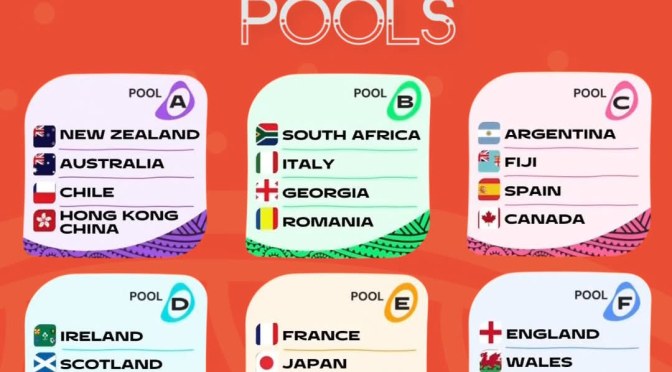
The Rugby World Cup draw took place last week, and the ‘big players’ have been dispersed across the Pools. The All Blacks and Wallabies meet for the first time in World Cup history in a round-robin match as the heavyweights of Pool A. South Africa and Italy headline Pool B; Argentina & Fiji in Pool C; Ireland & Scotland in Pool D; France & Japan in Pool E; and finally, England & Wales in Pool F. However, it is hard to go against the Springboks achieving a record fifth Webb-Ellis Trophy to make it three in a row under the leadership of Siya Kolisi.
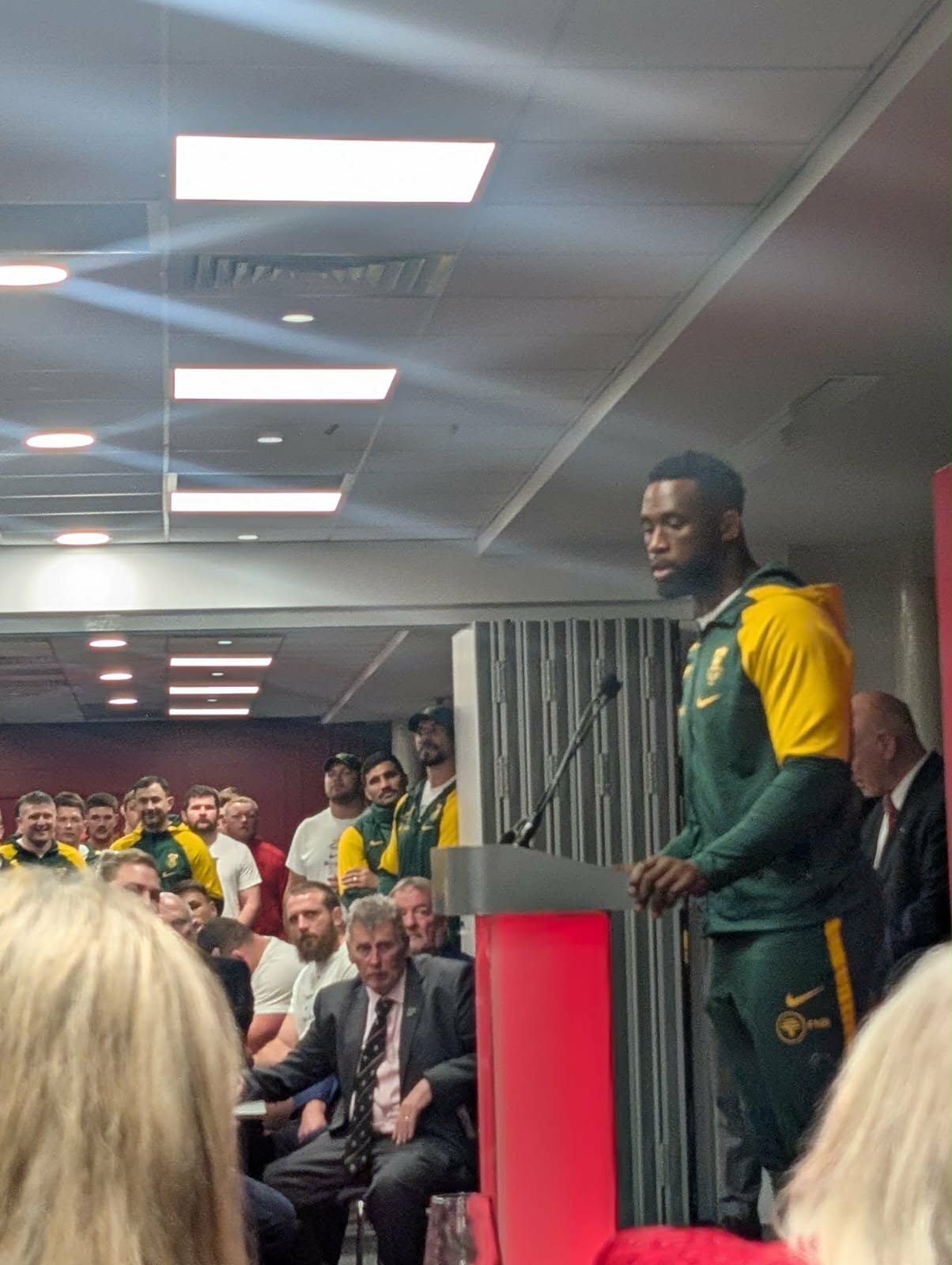
Siya Kolisi addressed the media in Cardiff. Courtesy of Brisbanerugby.
According to the World Rugby rankings, the round of 16 would mean that the Top two finishers in the six Pools, plus the next four teams placed after the round-robin stage. The eight winners would progress to the knockout stage.
The opening match will be held in Perth, likely between the hosts, Australia and New Zealand, to a record sold-out crowd. This will mean that these two teams won’t meet again until the final in Sydney. The All Blacks will have to negotiate a tough semi-final against the Springboks, while the Wallabies will have to overcome a mighty English side.
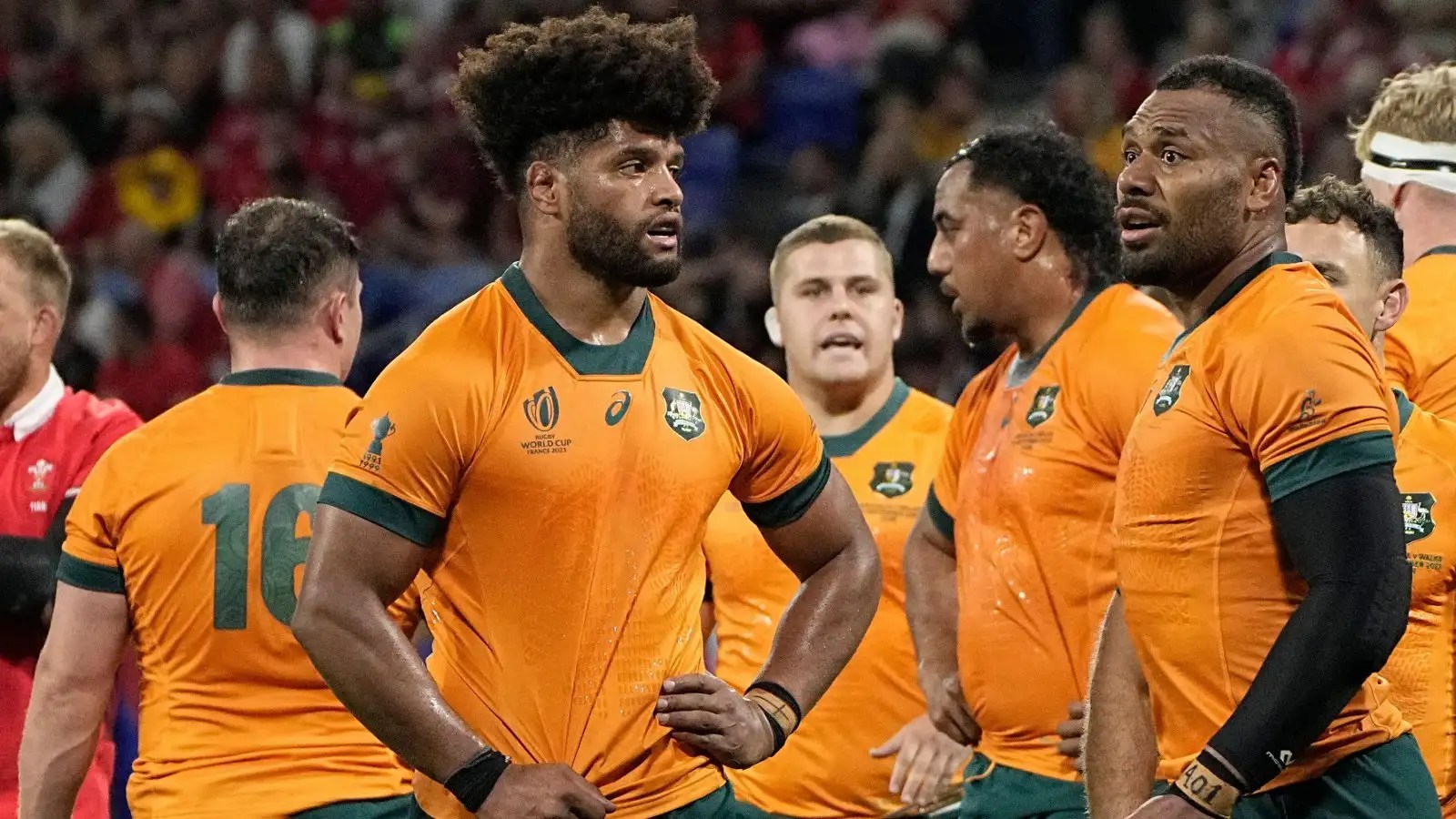
Wallabies in France at RWC 2023.
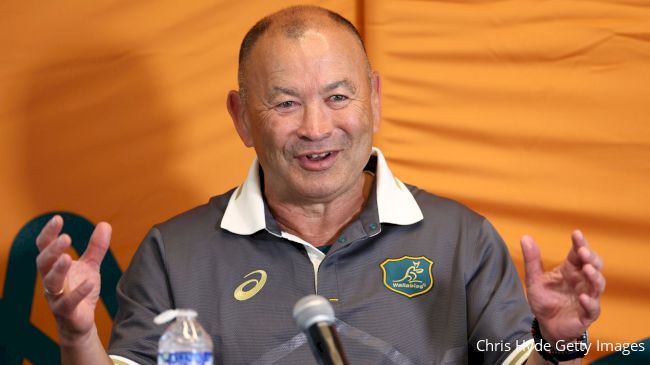
The Wallabies will have to play Japan in the quarter-final, a team they only managed to beat 19-15 at Tokyo’s Kokuritsugyogijo Stadium on October 25th this year. Eddie Jones’ men will be up for the challenge, possibly trying to replicate their RWC 2015 win over the Springboks in the Miracle in Brighton, arguably the greatest upset in not only Rugby World Cup history, but sport in general.
CJ in Tokyo at the Olympic Stadium. Courtesy of @brisbanerugby on Instagram
RWC 2027 is set up for the greatest contest in Rugby World Cup history, and the permutations will be studiously studied by the coaching staff of each participating nation, none more so than the mercurial Eddie Jones. Bring it on!!
As the Wallabies are about to embark on their spring tour to the British Isles and Ireland, we should assess where they are at. Coming off four wins from their nine matches this season, and being ranked 10th in the world, they are not in anyway achieving success.
Two wins over a weak, developing Welsh side and a shaky win over Georgia to start Joe Schimdt’s tenure has barely been a pass mark. Then, despite some positive aspects, going down to the world-champion Springbok outfit in two tests at home proved that there is still plenty of work to do with this team. A narrow one-point victory over Argentina followed by a massive 67-27 loss the following week exposed this side’s deficiencies.
Rounding out The Rugby Championship with a loss at home to the All Blacks and a week later losing in Wellington did not do the Wallabies any favours. Leaving Schmidt with only four wins from nine outings and the lowest ranking of 10th in the world provides plenty of homework for him ahead of the spring tour.
It hasn’t been all doom and gloom, though, with a wealth of talent exposed with 16 debutants given a chance. Carlo Tizzano was a standout coming in for the injured Fraser McReight and Dylan Pietsch showed he is up to world standard, particularly in his first run-on test in Wellington. Rob Valetini was a menace alongside Harry Wilson and McReight; and Taniela Tupou showed how tough he is but is barely getting through 40 minutes.
However, if the Wallabies are going to have any impact at next year’s British and Irish Lions tour, they are going to have to show plenty of improvement. The spring tour provides that opportunity. Bringing in overseas-based players such as Will Skelton does just that. Also, Quade Cooper or Bernard Foley to provide some guidance for Noah Lolesio, Ben Donaldson and Tom Lynagh. Even from left field picking one of Brisbanerugby’s top sons, Isaac Lucas, who is killing it in Japan, could be another solution for the lacklustre display at number 10.
CJ & Isaac Lucas courtesy of @brisbanerugby on Instagram
So the 2023 Rugby World Cup has been decided in Paris by one point between two giants of the rugby world in South Africa and New Zealand. As the rain came down at Saint-Denis the Springboks went about their business of acquiring points through the boot of Handre Pollard to be up 12-6 at half-time. The only points in the second half was an unconverted try by Beauden Barrett that left the All Blacks one short at the end to lose by the slimmest of margins, 11-12.
After seven weeks of intense battle, the two teams that had each won the tournament three times a piece, were left to fight the final battle. The Northern Hemisphere had said that the Southern Hemisphere were not up to standard, but some performances of Fiji and Argentina, in particular, were worth taking note of. Despite this, Australia performed badly losing to Fiji for the first time in 69 years and being thumped by Wales 40-6 in the Pool stages which meant they could not reach the knockout stages for the first time in World Cup history. A lot of the blame can be laid on the coach, Eddie Jones, for not preparing his young team to do better. As a consequence, he has resigned from his position.
However, the final came down to two teams that had lost one match each in their respective Pool matches. New Zealand lost to France, 13-27, and South Africa lost to Ireland, 8-13. Ironically, those matches were reversed in the quarter-finals where New Zealand defeated Ireland, 28-24, and South Africa defeated France, 29-28. While the All Blacks had an easy route over Los Pumas, 44-6, in the semi-final the Springboks did it much harder against a determined English side to win by a single point, 16-15.
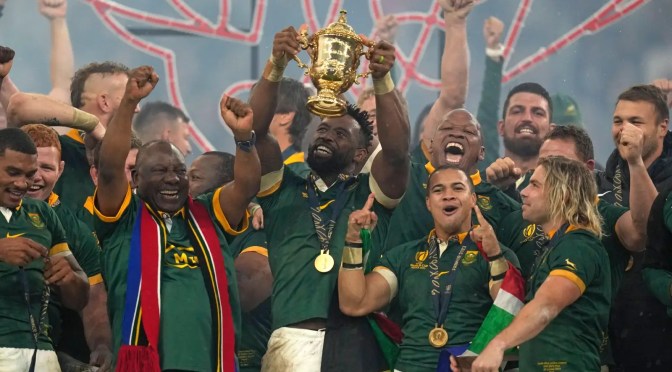
It is a true testament that the Springbok team could galvanise under Siya Kolisi to win a fourth Webb-Ellis trophy, back-to-back champions. And not just the team as Kolisi says, “Our country goes through such a lot and we are that very hope that they have”. They had plenty of support in the crowd as well, none more so than tennis great Roger Federer whose mother is South African. Well done!
Well technically not, as it’s only the third biggest global sporting event. A mere 20 nations qualifying after an exhaustive elimination process, however, the tournament is three times longer at six-weeks and 12 venues from Hokkaido to Kyushu. The influx of foreign invaders will be the greatest since Commodore Perry’s arrival in 1853 at Shimoda.
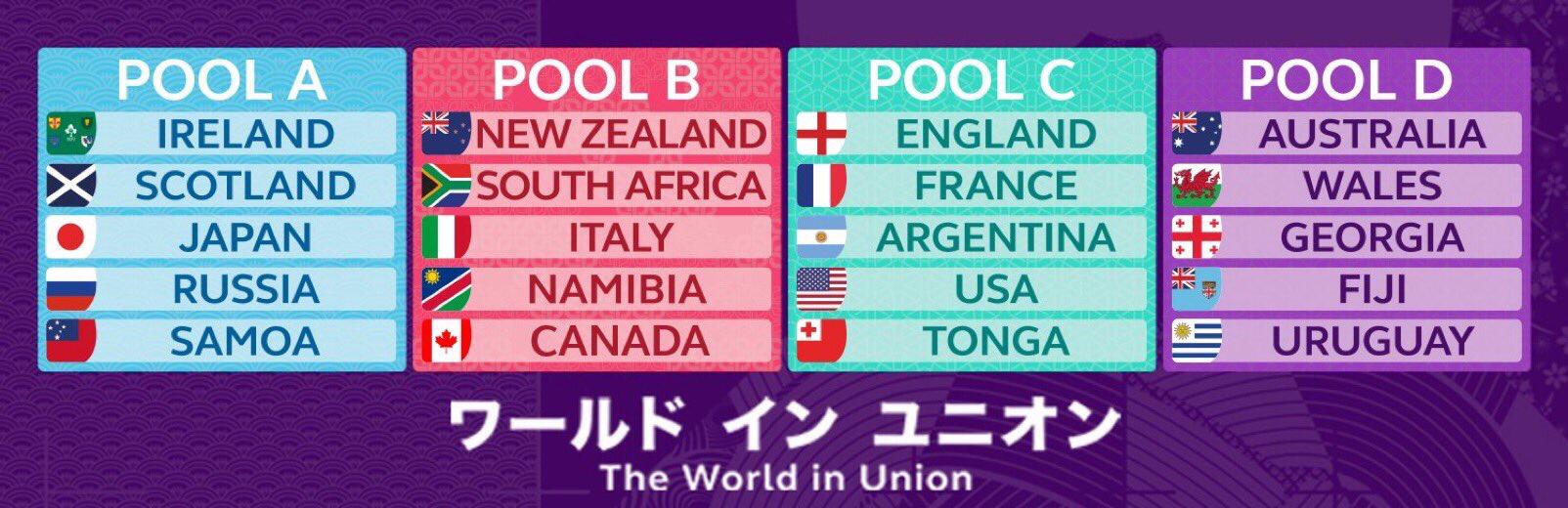
The four Pools of five competing for a place in the knockout series.
Perennial favourites the All Blacks from New Zealand will be looking for an unprecedented three-peat, having won the last two incarnations in 2011 & 2015. Although, Ireland will go into the tournament as World No. 1, due to the quirky World Rugby algorithm that determines placings. Never before have the ‘Men in Green’ made a RWC Final, although their Quarter-Final match against RWC1991 winners, the Wallabies, at Landsdown Road will go down as ‘the one that got away‘.
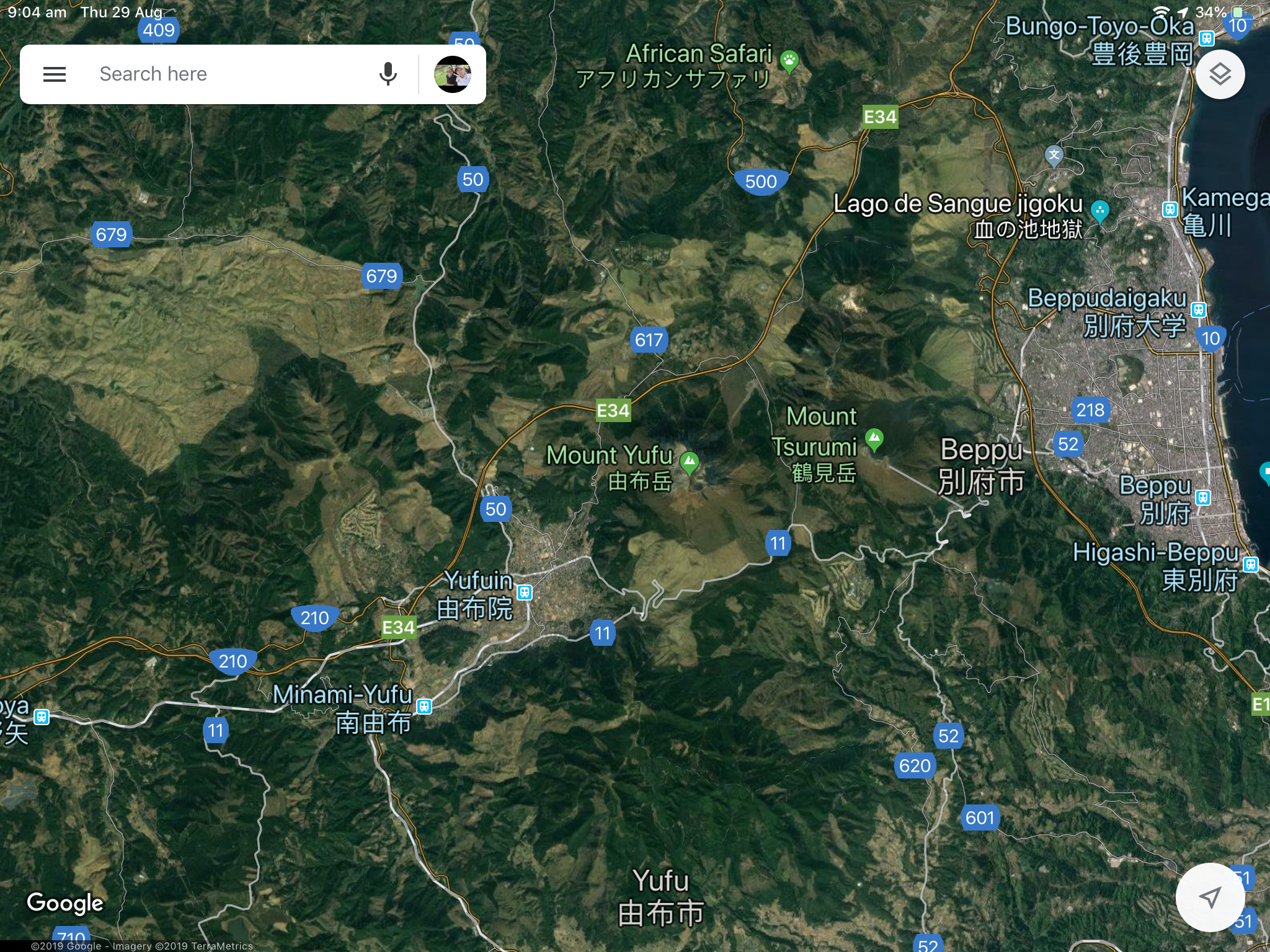
The teams descending on Japan, somewhat delayed due to Typhoon Faxai, should be embraced by the Japanese populous along with the tsunami of international supporters. Rugby people are a different breed: beer-swilling aficionados as opposed to football (soccer in the English speaking world outside of England) hooligans. They will appreciate the culture, the ceremonies, the nature and the history that abounds there; as well as the onsen or hot springs, the most renowned are found in Beppu, Kyushu; with matches played in Oita, including two very important quarter-finals, these are a must-see (map below).
Visiting Japan 12 months out from the Rugby World Cup I got a sense that the ‘general’ Japanese population were somewhat unaware of the tournament. When questioned they would reply with, “Tokyo 2020?” Just last week at a theme park on the Gold Coast some university students visiting from Japan on their summer break in Australia looked puzzled when I said I was going to Japan for the Rugby World Cup (admittedly, they were from Ibaraki Prefecture, an hour or so north of Tokyo on the Joban Line, where no matches are being played). Also in Australia, when people ask why I am going to Japan the response often is, “Do they play rugby in Japan?”
Undoubtedly, when RWC2019begins this Friday at Ajinomoto Stadium the vast majority will get on board. Not everyone is a diehard rugby fan, but when a spectacle such as the Rugby World Cup is on your doorstep you can be assured that the populous will respond and Japanese ‘omotenashi‘ (hospitality) will come to the fore. At the 2015 tournament, 25 million in Japan tuned in to watch Japan v Samoa on their television sets, so the interest is there. The other takeout from that tournament held in the UK was the 34-32 last-minute win over the Springboksby the Japanese Brave Blossoms; recreated in cinema with the just-released “Miracle in Brighton“.
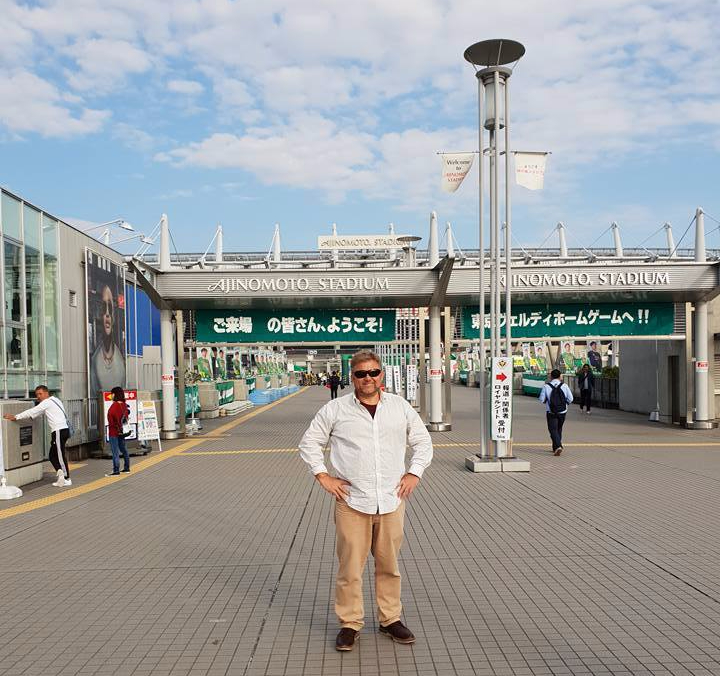
CJ last year at Ajinomoto Stadium, Tokyo.
Rugby Union has a long history in Japan dating from 1866 in Yokohama and, while being more popular in the universities, the company based Top League has started to attract larger crowds. Unfortunately, Japan’s Super Rugbyteam the Sunwolves will be axed from the competition after the 2020 season, though I’m sure their company based Top League will eventually open up to international teams from Hong Kong and Perth (convincing the JRFU will be a challenge, though).
All and all this bodes well for a spectacular tournament that I am very much looking forward to attending. 楽しみですネ‼
With Japan being awarded this year’s Rugby World Cup, you could be thinking that the Japan Rugby Football Union (JRFU) would be going out of their way to promote the game. On closer inspection it looks like quite the opposite.
Firstly, the JRFU basically cancelled the Top League Competition for the 2019-20 season, replacing it with two mini tourneys in 2020. Then they told SANZAAR in March that they really didn’t think Super Rugby was the best way to develop the national side and now former Prime Minister, Yoshiro Mori, call’s for the JRFU to be reformed after announcing his shock resignation last week as the organisation’s honorary chairman. He is the man responsible for Japan hosting RWC2019.
Mori-san is not the only one at odds with the JRFU, as former Japan national coach, Eddie Jones, reiterated with Kyodo News in Japan, yesterday, his opinion regarding the JRFU allowing the Japanese side the Sunwolves to be disabandoned after the 2020 Super Rugby season.
“If Japan wants to be a top 10 country in the world, which they do, they need their players to be prepared,” the current England coach, Jones, said.
“The purpose of the Sunwolves was to give opportunities for young Japanese players to prepare for test rugby, because ultimately like any rugby country you want your national team to be strong and your grassroots to be strong, and in between you work out the right structure.
“What Japan was missing was that opportunityfor younger players to go from a good domestic Top League into a higher level of competition without being exposed to test level, and the Sunwolves provided that opportunity. It hasn’t worked out for them and I think it is a massive opportunity missed.“
Eddie Jones speaking with Kyodo News’ Rich Freeman in Yokohama.
LONDON, ENGLAND – NOVEMBER 19: Eddie Jones the head coach of England looks on during the Old Mutual Wealth series match between England and Fiji at Twickenham Stadium on November 19, 2016 in London, England. (Photo by Richard Heathcote/Getty Images)
Remembering, of course, that Eddie Jones prepared the Japanese Team for the 2015 Rugby World Cup, so he knows what he’s talking about. Putting his chargers through a somewhat grueling experience on Japan’s southern island of Kyushu ahead of that tourney, they certainly reaped the glory with their win at RWC2015 in Brighton. To overcome the might of South Africa’s Springboks at rugby’s showcase tournament is the story of legends and a movie under the title of, ‘Miracle in Brighton,’ is already underway.
Japan’s Brave Blossoms celebrate their 34-32 victory over South Africa at RWC2015. Photo courtesy of Getty
World Rugby Chairman, Bill Beaumont, has used the World Cup in Japan to promote rugby throughout Asia with a target of one million new participants. In December last year, Beaumont announced that this target has been achieved at a special event celebrating 50 years of Asia Rugby in Bangkok.
While the vast majority of those numbers have been in Japan, about 460,000. Many of which have been involved in one off tournaments such as the one I attended at the YC&AC grounds last September in Yokohama run by Australian Peter Gibson called the “Hero’s Cup” with former Japan captain Hitoshi Ono.
CJ with Japanese rugby legend Hitoshi Ono at an Aussie Beef rugby tournament at YC &AC
According to veteran rugby scribe in Japan and good friend, Rich Freeman, the inflated numbers for Japan are not telling the true story. As rugby numbers are actually on the decline.
“In the present way it’s structured it just doesn’t work. Schools are losing rugby clubs big time,” Freeman says.
“Rugby is struggling, especially at school level, so they’re going to have to change the way it’s structured.”
The main problem is that there are no consistent pathways, unless your child attends a rugby school and that is the only sport they are allowed to play 330-340 days a year. Those that don’t attend are going to feel left out after the World Cup with nowhere to play rugby.
“You’re going to have all these young kids saying, ‘Wow, I watched Beauden Barrett play and he did this, I want to play,’ but unless there are more clubs like Koji’s (Tokumasu) Shibuya Rugby Club, where are they going to go?”
Koji Tokumasu runs the Shibuya Rugby Club which is one of only a few clubs introducing Tokyo kids to the sport through tag rugby. He is a senior director for #RWC2019 organising committee and says the JRFU needs to pick up it’s act.
“Every Sunday we have over 300 under 12’s playing tag rugby and even if they don’t have the opportunity to play at school they can play at our club. I’m hoping and confident that will increase, so the Japan Rugby Union and schools should be prepared to open the door when this happens.”
The urgency for exposure is apparent with only six months before the Cup kicks off at Tokyo Stadium (Ajinomoto Stadium) on September 20th with Japan hosting Russia in Pool A. Many people I talked to in Japan last year were overawed by Japan’s success at the last World Cup in England four years earlier. Not just the win over South Africa, the match between Japan and Samoa achieved a television audience record of 25 million in Japan.
CJ at Ajinomoto Stadium last year.Courtesy of @brisbanerugby on Instagram
Some of the team jerseys that will be at the RWC2019. Photo courtesy of CJ on Instagram @brisbanerugby.
From the inception of the Rugby World Cup in 1987, where Australia and New Zealand hosted the inaugural event, the manifestation of this great tournament has been at the forefront of international attention. None more so than the 1995 tourney in South Africa with the Springboks competing for the first time for Nelson Mandela’s newly minted, Rainbow Nation. Who would forget the galvanising of a population under the same banner through rugby union? It was the inspiration for the book, “Playing the Enemy“, by English journalist, John Carlin, that inspired the 2009 movie, “Invictus” directed by Clint Eastward.
Nelson Mandela presenting the Webb Ellis Trophy to Francoise Pienaar RWC 1995. Photo courtesy of news.com.au
Four years later at RWC 1999, former Wallaby captain and Australian rugby commentator, Andrew Slack, stated ahead of the New Zealand v France semi-final in Twickenham, that he would move to the Tongan capital of Nuku’alofa if France won. When the French came from 24-10 down at halftime to upstage the Kiwis 43-31 by the fulltime whistle, Slack was packing his bags. The final that year saw the Wallabies, under John Eales leadership, win their second Webb Ellis Trophy, 35-12 over France.
Despondent All Blacks side after RWC1999 semi-final loss to France. Photo courtesy of planetrugby.com
By 2007, the tournament moved to an exclusively non-English speaking nation France. However, the memorable French 20-18 win over the All Blacks in the quarter-final was in Cardiff, Wales. Incendently, the Argentine Los Pumas affirmed their rugby pedigree defeating the French hosts twice. This time it was the South Africans that clinched their second title, 15-6, over England at Stade de France, Saint-Denis in Paris.
Los Puma’s halfback, Augustin Pichot, celebrates after their 17-12 victory over hosts France in the opening match of RWC 2007. Photo courtesy of The Irish Times.
It was the 2011 edition that finally saw the mighty All Blacks overcome 24 years of ridicule and derision to secure their second Webb-Ellis title. In front of 61,079 home fans at the sacred Eden Park, the crucible of rugby in New Zealand, the ABs overcame their nemesis, France, to hold on by the slightest of margins, winning 8-7. Despite the valiant efforts of the French captain, Thierry Dusautoir’s, Man-of-the-Match performance, Les Bleus, couldn’t overcome the Maori challenge.
New Zealand All Blacks do the Haka ahead of the RWC 2011 Final with France. Photo courtesy of the Irish Times.
The Rugby World Cup unites diverse ethnic cultures and languages. It brings the so-called second tier nations to compete against the best teams on the planet in front of huge crowds with a global audience. In RWC 2015 the average attendance across all 48 matches was 95.27%, the most well-patronised event with a total of 2,477,805 in attendance (Wikipedia 2018). The match between Japan and Samoa achieved a television audience record of 25 million in Japan and ITV in the UK recorded 11.6 million viewers for the England v Wales match (RWC site). However, the biggest revelation to come from RWC 2015 was the “Miracle in Brighton“, when the Eddie Jones coached Japan Brave Blossoms defeated the South African Springboks 34-32 after the fulltime siren. This has inspired Australian writer and director, Max Mannix to produce a movie of the lead up to this extraordinary occurrence, with filming commencing on Australia’s Gold Coast this month.
The jubilation on the Japanese team’s faces after defeating South Africa in RWC 2015 in Brighton. Photo courtesy of telgraph.co.uk
This year the Rugby World Cup carnival, for the first time, moves to Asia and the Land of the Rising Sun. Japan will host the third biggest sporting event on the global stage, with big shoes to fill after the successful UK edition four years hence. Action starts in 8 months with the opening ceremony on September 20th at Ajinomoto Stadium, in Tokyo’s western suburbs, followed by hosts, Japan, taking on Russia through to six weeks of competition culminating with the final at the cavernous 72,327-seat Nissan Stadium in Yokohama.
4年に一度じゃない。 一生に一度だ。
“Not once every four years. Once in a lifetime!”
Such a bold statement, though justifiably so with the tournament making an initial foray into the Orient, laying testament to the multitude of cultures that make up the rugby family. The Hong Kong Sevens continually draws on this diversity to host the most successful annual 7s rugby pilgrimage there, but for the Rugby World Cup to be held in Asia, this will surely be a once in a lifetime experience.
From the northern ocean roads of 北海道(Hokkaido)to the nine states of 九州(Kyushu)in the south, across 12 stadiums with dedicated host cities, rugby fans will be treated to not only 48 high-quality international rugby matches, but a sensory overload in this ancient country of temples, shrines and castles coupled with exquisite culinary delights presented to the highest caliber. Bring it on!!
The Wallabies at Odawara Castle near their training facilities. Photo courtesy of CJ on Instagram @brisbanerugby















 Brisbane Rugby.com