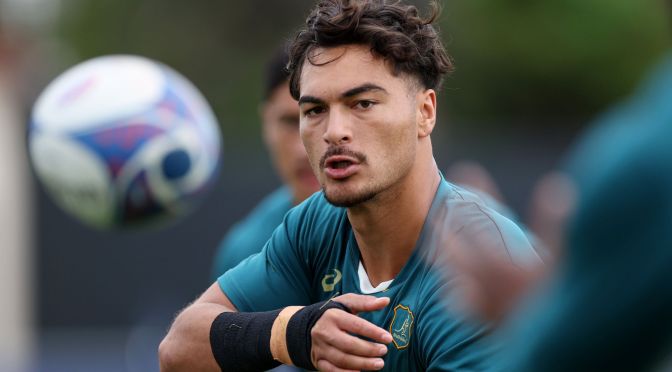
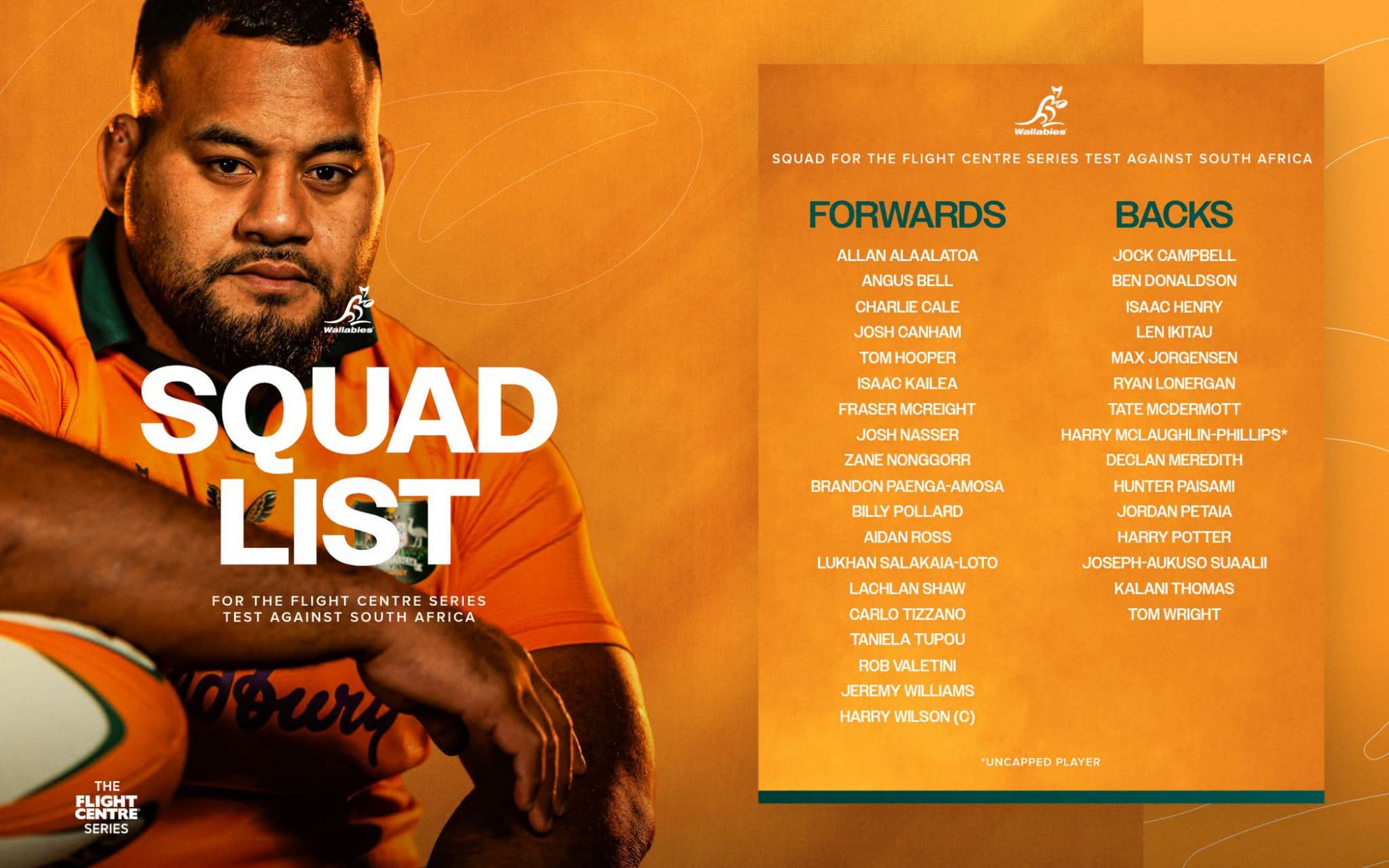
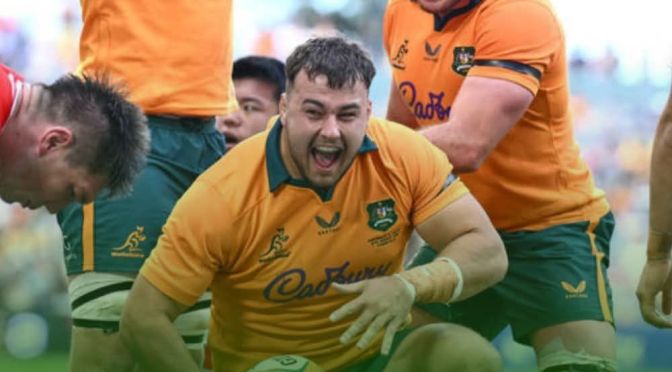
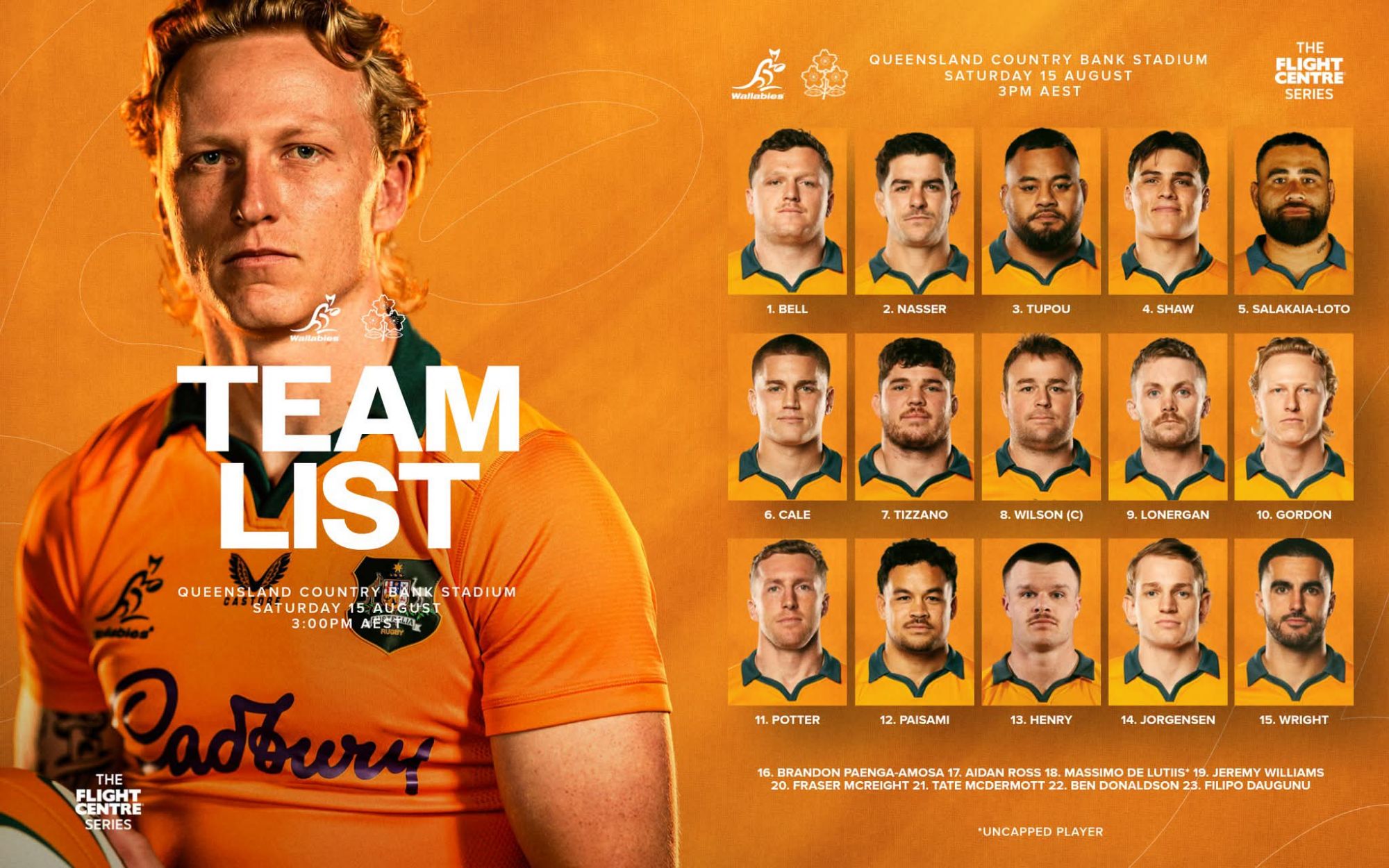
It’s why Stephen Larkham should be the next Wallabies coach. Developing players through Super Rugby gives you intimate knowledge of what they offer the Wallabies setup. Dropping someone like Eddie Jones into the role, without insight into up-and-coming players, was a bridge too far that proved disastrous for our chances at the Rugby World Cup 2023 in France. Two names on Les Kiss’ list for the Springboks’ Test in Perth, Jordan Petaia and Harry McLaughlin-Phillips, are additions to the squad; both seasoned Queensland Reds players whom Kiss has coached.
Wallabies squad to play the Springboks in Perth. Photo courtesy of @wallabies
HMP has not been cooling his heels with a XXXX; he was the best on field in a losing Wests side against Brothers, 51-14, at Ballymore in the Hospital Cup GF last month, and he orchestrated a come-from-behind victory with the Western Force over Queensland, 29-28, last weekend at the same venue to show that, despite being small in stature, he’s a force to be reckoned with.
The real excitement package is Brisbanerugby’s favourite son, Jordan Petaia. He debuted at RWC 2019 in Japan as a 19-year-old and was destined for a long Wallabies career until his dream of playing American Football (Gridiron) drew him away. He had Kiss’ blessing to pursue that dream, and now he calls him back under the Wallabies tent before he heads off to “The Land of the Rising Sun” to play for Urayasu D-Rocks in the Japan League One competition. Kiss said:
“He’s been out of the Australian system for a while, but it was important that we broaden our understanding of what’s available and how they’re looking.
“There are a lot of good back three in our country at the moment that are playing here.
“That’s what the importance of Super AU is for us, so we can look at these players and see them in action and keep a good eye on them. Jordan being a bit further away, being in France recently, we just felt it was the opportunity to bring him in and have a good look at him.
“Positionally, we know he’s covered wing, 15 and 13 in the past, so once he hits the ground with us, we’ll have a good look at it, but it’ll be definitely in one of those positions. Likely a back-three position, I’d say, at this stage.”
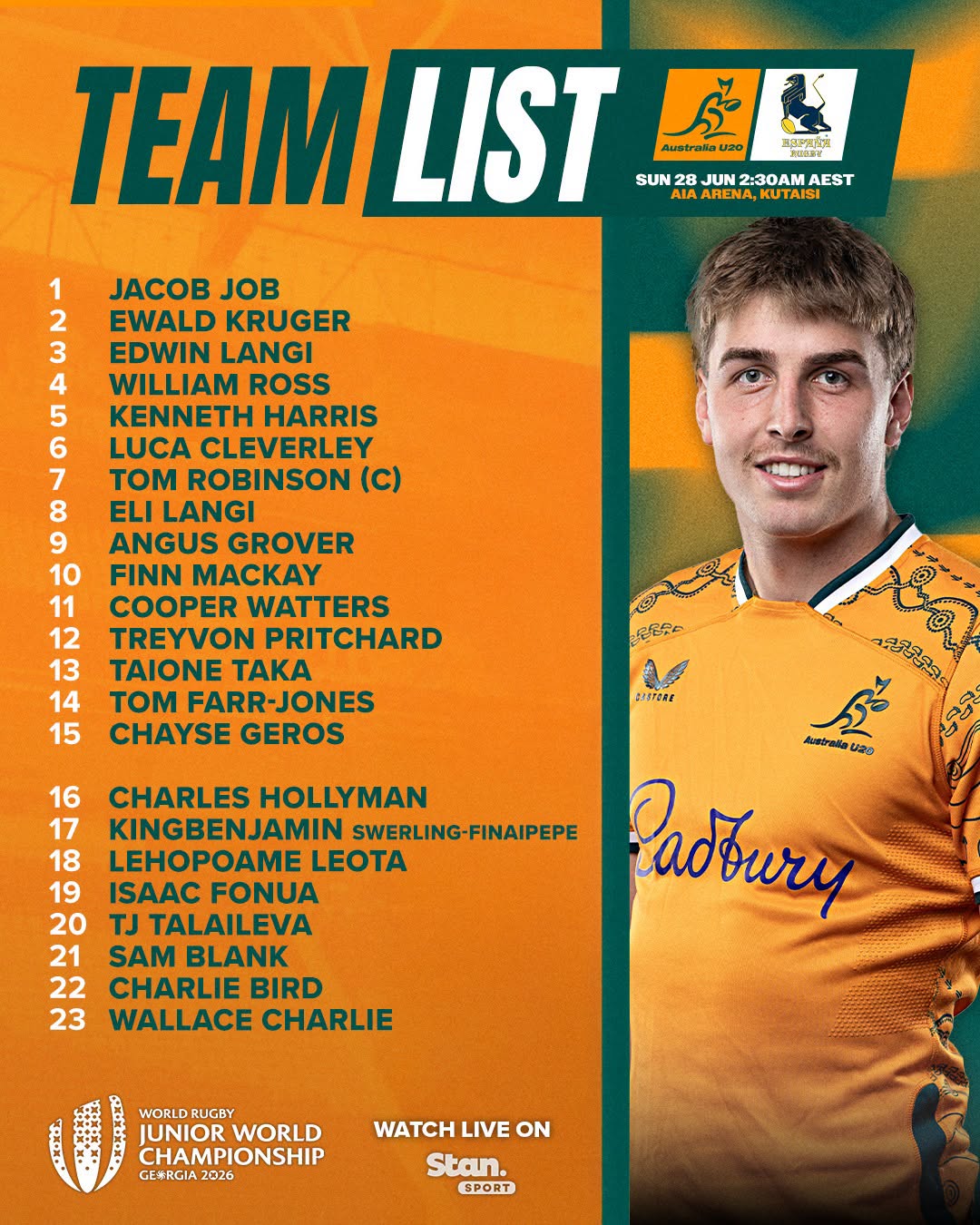
The poisoned chalice at No. 10 may not be such a curse, as some exciting five-eighths are coming through the ranks at the Queensland nursery. Finn Mackay, who starred at the recent U20s championships in Georgia, already having a Reds contract, and the St. Joseph’s Nudgee College Chilli Smith, son of Wallaby halfback the recently passed Brian Smith, carved it up in the Brisbane GPS competition, winning a fourth consecutive Premiership last weekend. And don’t forget Tom Lynagh, who was effective in driving his Queensland Reds side to a 21-12 halftime lead in his 40-minute cameo at Ballymore at the weekend.
Bouyed by his team’s narrow 35-32 loss the week before in Osaka, Eddie Jones was talking up a Wallaby takedown in their backyard. Especially since they will likely take on the Wallabies in the Round of 16 in Brisbane at next year’s Rugby World Cup in Australia. If anyone can do it, it would be Jones, having shocked the rugby world at the 2015 Rugby World Cup by defeating the might of South Africa 34-32 at the death in the Miracle in Brighton. However, in Townsville, a happy hunting ground for the Wallabies, it was not to be as Les Kiss’ men turned on the blowtorch for the second half to blitz the Brave Blossoms with 35 unanswered points to take the match 56-17.
The Brave Blossoms are not that easy a side as when the All Blacks thrashed them 145-7 at the 1995 Rugby World Cup in South Africa or the 91-3 defeat by the Wallabies in Lyon at the 2007 Rugby World Cup. They had their Miracle in Brighton win and backed it up at home in the 2019 World Cup, topping their pool by beating Ireland (19-12) and Scotland (28-21) along the way. Fast forward to 2026, and Eddie Jones, back at the helm, has plucked a young 21-year-old out of Meiji University, Ryunosuke Ito, without any professional rugby to play five-eighth against a resurgent Italian side, coming off wins over Scotland and England at this year’s Six Nations Championship, to play at Tokyo’s iconic Chichibu-no-Miya Stadium. It was a full house on a sunny 4th of July day in Tokyo’s Shinjuku Ward, where the Brave Blossoms delivered an emphatic 27-10 win. Our own Nic Berry was blowing the whistle that day.
So, the two matches against Japan, although ranked 4 places below us, were always going to be tricky for a new coach. Les Kiss wasn’t inventing the wheel and wasn’t about to make drastic changes to the side Joe Schmidt had assembled. As Ryan Lonergan said, it was more about “Evolution, not revolution”. The three-point victory at Osaka’s Hanazono Stadium in the oppressive heat and humidity was a lucky escape to notch his first win for the Wallabies.
With the shackles now removed, Kiss finally picked a team more to his liking, upsetting Waratah supporters with a strong Reds flavour, with 11 in the match 23. The return of Lukhan Salakai-Loto, arguably the best Aussie performer in Super Rugby Pacific, alongside Isaac Henry pairing with Hunter Paisami and Carter Gordon in the midfield just seemed so natural. Kiss had nurtured these boys’ injuries at the Reds during his tenure over the last three years and knew intimately how much they had trained and rehabilitated. That faith was repaid in spades at Country Bank Stadium last weekend, and now a more confident squad embarks on their South American tour for two matches against a very formidable foe in Argentina, just ahead of the Wallabies in the latest world rankings.
Kiss gets to pick the side he wants in Townsville. Photo courtesy of the Wallabies.
I’m sure everyone remembers the infectious Brave Blossoms’ halfback Fumiaki Tanaka. The little general made his mark on Super Rugby for the Highlanders with his speed and crisp service from behind the ruck. He was not a university prospect, but joined the Panasonic Wild Knights in 2007, where he played alongside Tony Brown, who was instrumental in bringing him to the ‘Landers (Wikipedia). At 166cm and 72 kg, he’s one of the smallest players to play international rugby, but a very inspirational one.
In Brisbane, there’s a young 20-year-old student, Risa Hayashi, playing halfback for the UQ women’s team. A fiery young prospect making her mark on the competition. I caught up with her earlier in the season at Jeeps ‘ home ground at Yoku Road, Ashgrove. Originally born in Dubai, her mum is from Kanagawa, next to Tokyo, and her father is from Osaka. She has prospects of playing in Japan.
Hayashi is not a trailblazer, though, as that honour goes to Asako “Diji” Ono. Ono also played for UQ Women’s, then went on to represent the Reds and Wallaroos at halfback. Originally, coming to Australia as a young, naive 16-year-old student chasing her dream to play rugby, she now mentors other women to better themselves. Currently teaching at Churchie, where one of her Mathematics students, Rio Shimizu, is also from Japan and is a halfback for the 1st XV team.
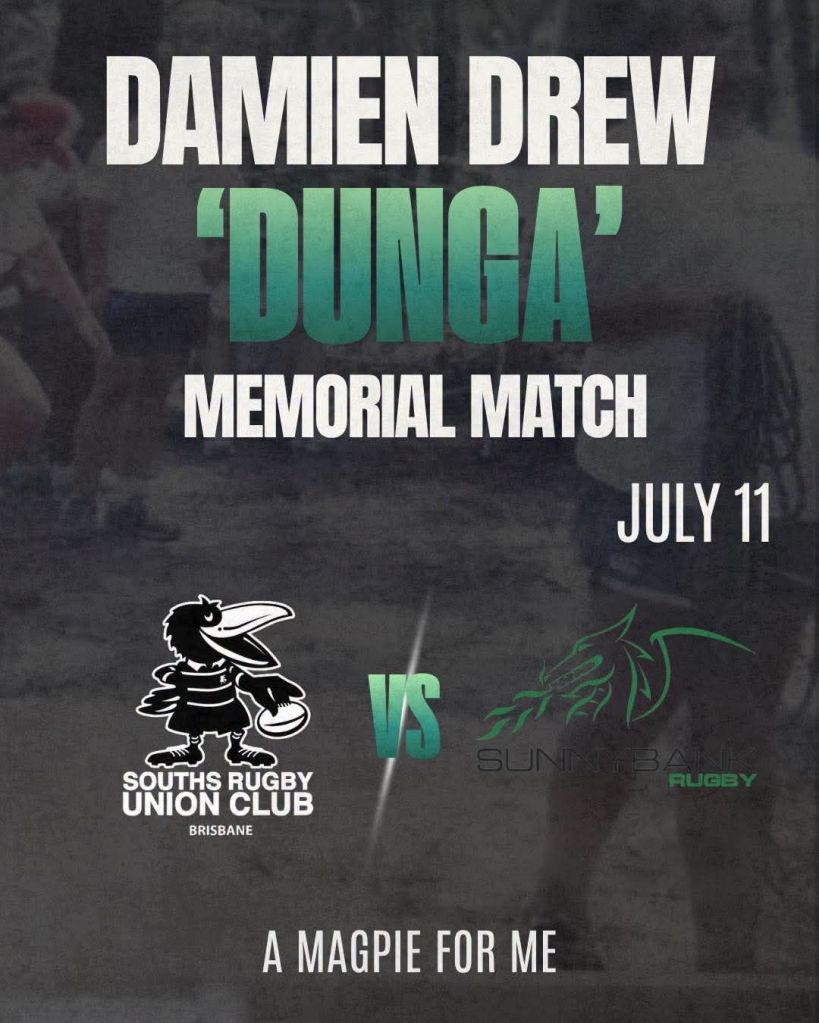
Mark it in the calendar, this is set to be a massive day at Chipsy Wood Oval.
We’ll be hosting Sunnybank in the annual Damien “Dunga” Drew Memorial Match, a special day to honour a Souths legend and celebrate everything he meant to our club.
With a full day of rugby, great atmosphere around the grounds, and the Wallabies game streamed live on the big screen in the clubhouse afterwards, there’s plenty to look forward to.
Get your teammates, family and mates together and make a day of it. See you at Chipsy. 🖤🤍
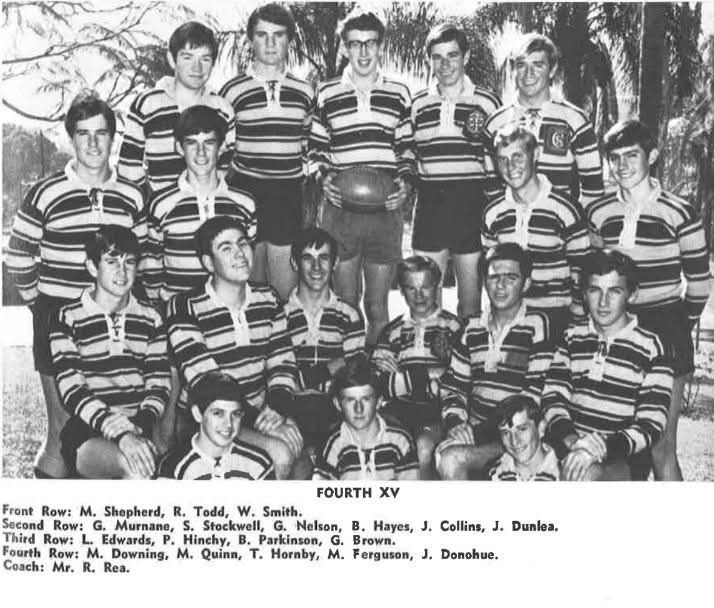
This old boy of St. Laurence’s College, South Brisbane (1970) was, by his own admission, not much of a rugby player, but week after week he turned out on the fields of Brisbane and in Year 12 was a fixture in the College 4thXV.
Wayne Smith’s rugby team at St. Laurence’s
His lifelong love of Queensland and Australian sport, and Rugby Union, in particular, impacted sport in Australia more than many know. He was the first person to lobby the leaders of the City of Brisbane and the State of Queensland to bid for the 2032 Olympics. So, in July 2021, as expected, Brisbane was confirmed as the host city for the 2032 Olympic Games. You can rightfully raise a glass to this SLOB (St. Laurence’s Old Boy).
(Note: I have collected information from a number of sources for this instalment, and some of the work is the property of Rugby Australia and The Australian newspaper.)
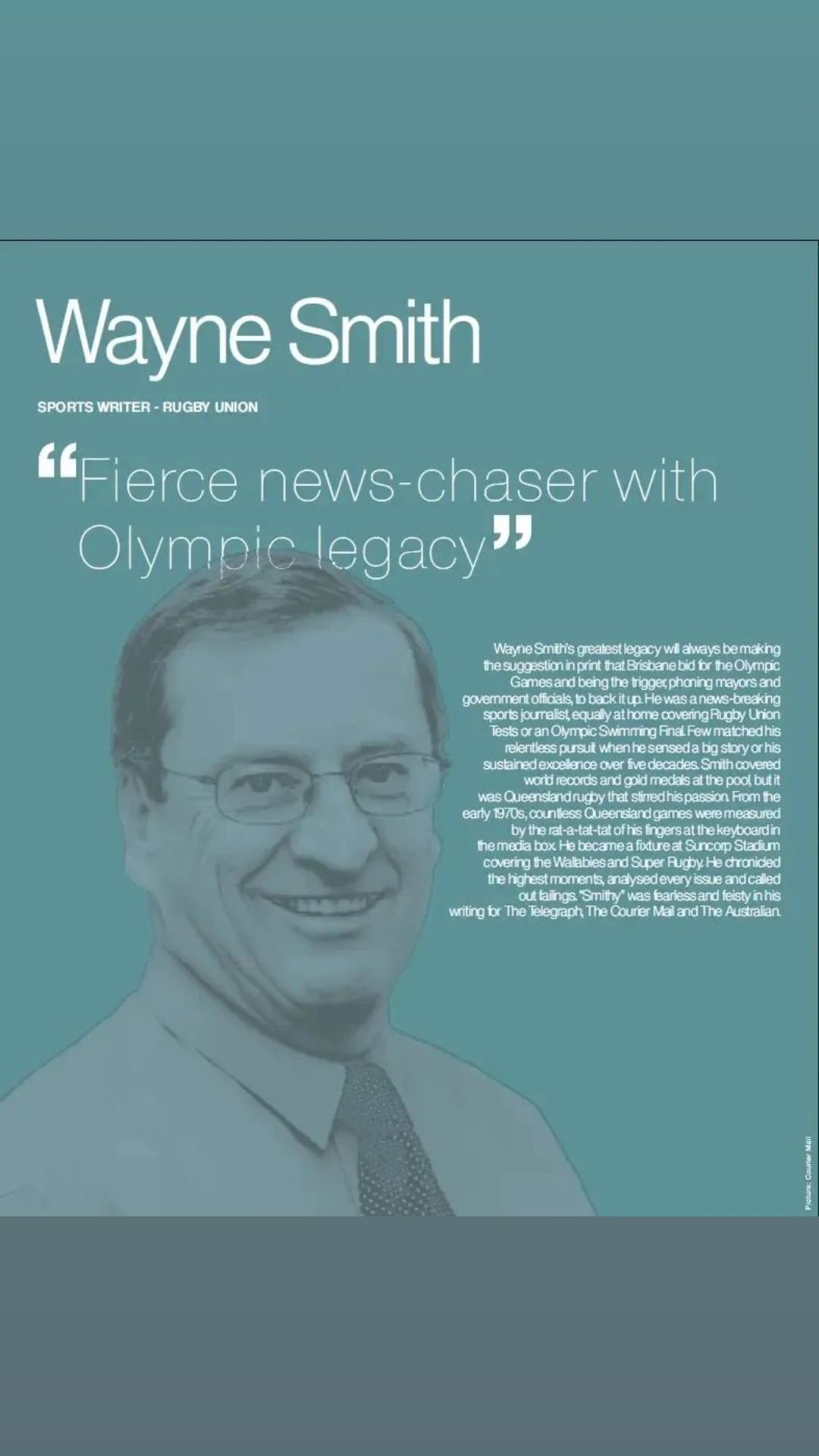
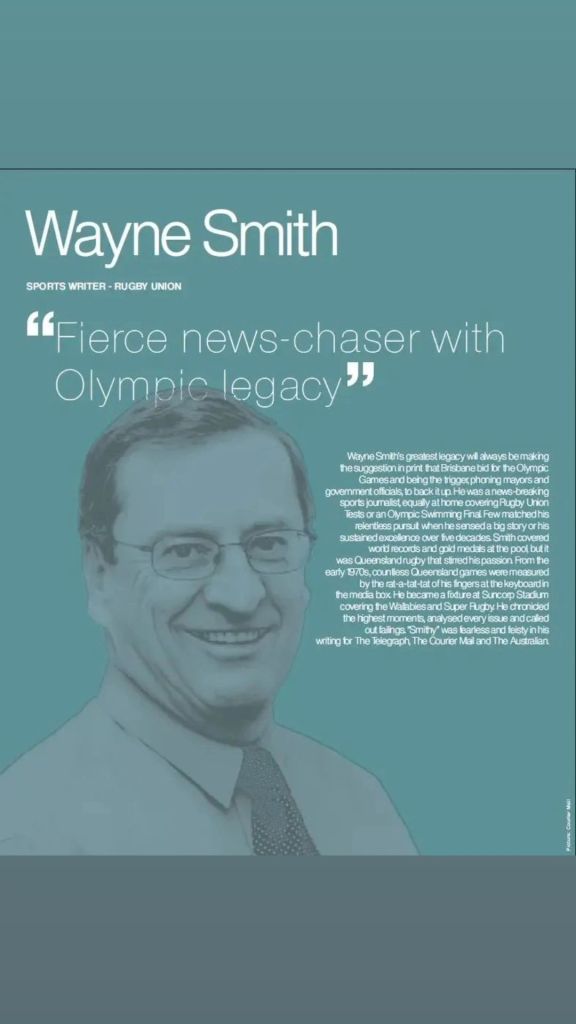
Whatever happened to Wayne Smith, SLC 1970?
Starting on Australia Day 1971, a young 17-year-old commenced his cadetship at the Brisbane Telegraph at the furthest possible point from a Rugby Field. “My very first assignment in journalism was to go out and interview the family of a bloke who had tried to run a level crossing and not quite make it,” Smith recalled. “I remember walking into this house, and down the corridor, I could see a grieving widow, half a dozen kids screaming and a priest. I thought to myself, nah nah, I’m not going in there, and this was my introduction to journalism…day one.”
A few weeks later, transitioning to the sports desk, with his predecessor going off to write a book of poetry. “A search of the company files revealed that I had played Rugby. The fact that it was the 4th XV at St Laurence’s College was good enough, and I got the gig.” With a stellar Rugby career in the 4th XV, he was perfect for the job, and it came as no surprise that Smith’s first question to the sports editor was, “Where’s Ballymore?”
Smith notes that the leading Rugby writer at the time was Frank O’Callaghan, who later went on to be known as Frank O’Rugby. Incidentally, one of Frank’s grandsons, Tom, is playing in the 2021 SLC 1stXV. Upon venturing into the press box at Ballymore for the first time, “watching Brothers score some very complicated try involving most of the players.”
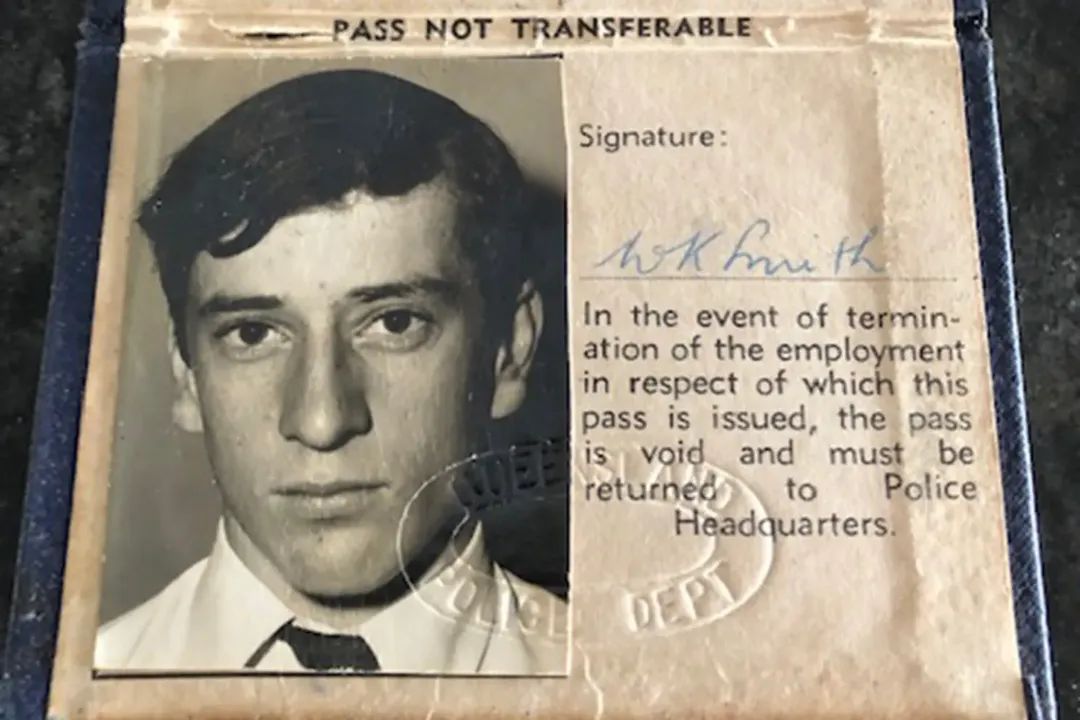
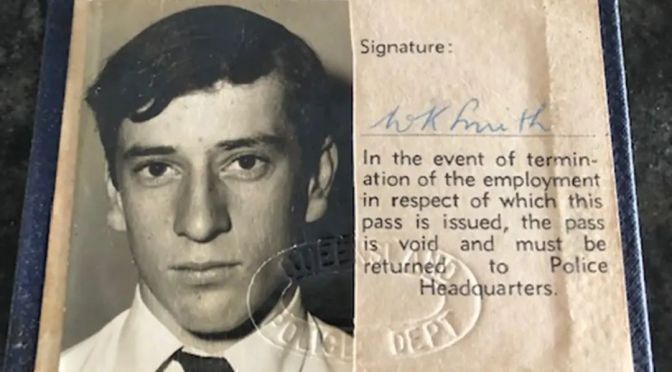
He called on the experienced O’Callaghan for an explanation as to what had happened. However, he was met with a “not a clue” as he quickly wrote down all that had transpired. This professional relationship developed into a fierce rivalry, which was all in good fun. Acquiring his first press pass through the Queensland Police in 1971, following the infamous Springbok tour, a young Smith continued to take any match assigned to him.
Wayne Smith’s first media pass.
“My first representative match was Queensland vs the British Lions, which Queensland won!” Covering the match for AAP, Smith filed the story, never thinking very much of it. However, the story took off when it was published internationally. “The London papers ran my story the next day, and then AAP filed a reaction piece.” “So, my debut representative Queensland story had circumnavigated the globe in the space of about twenty-four hours…, and with that, I was pretty chuffed.”
The first Test that Smith covered was Australia’s second Test match of the tour against the Springboks, which Australia lost. Smith’s four-tabloid-page match report took four copy-takers to transcribe on the other end of the phone, such was the level of detail. Smith later asked a close friend and aspiring journalist, John Mickel, a fellow SLOB, to sit beside him and help take statistics. Smith says Mickel found journalism far too tricky, and he later became the speaker of the Queensland Legislative Assembly.
Smith’s breakthrough later came in the mid-70s with the infamous ‘Battle of Ballymore’ and Queensland’s 42-4 victory over New South Wales in 1976, seeing him preside over “the dawn of Queensland Rugby”.
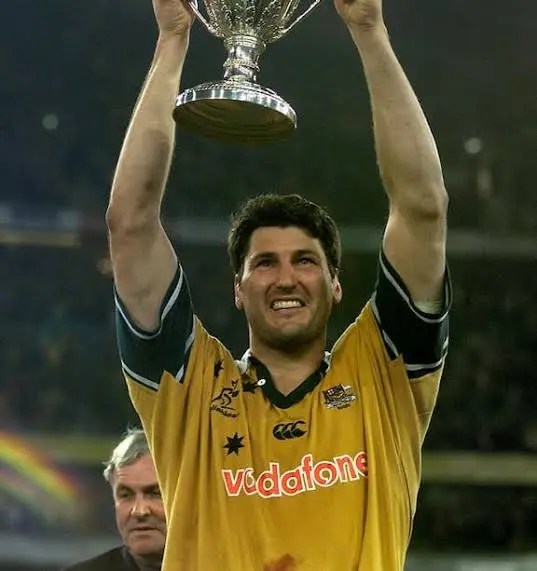
When quizzed on the best player he’s seen to date, Wayne wasted no time. “John Eales, I remember the first time I ever saw him playing, he was making his first grade debut for Brothers, playing number eight. I recall him taking the ball way out near his own sideline at the halfway line. He initially looked bewildered before deciding to take a field goal.” And it was this 55m field goal that had not only journalists but Australian selectors in awe. Smith recalls turning to John Connolly, who was chairman of the Queensland selectors at the time and saying, “If you don’t pick this guy for Queensland, I’m going to have your guts for garters.”
John Eales (Photo courtesy of Brett Phibbs, NZ Herald)
Fortunately for both Connolly and Queensland, Eales went on to become a legend of the game. Smith is proud to state that he was the one who broke the news to aspiring Wallabies centre Tim Horan, who was scheduled to play his first Test in 1989. “I remember ringing him to tell him he had made the Australian team, and he got quite a shock and was then quite excited by the news”.
Wayne believes that Tim, the son of SLOB Mike Horan, is the greatest centre to have played the game. Moving up the ranks at the Courier-Mail in 1993, Wayne missed coverage of the “golden era” of Australian Rugby. He returned to Rugby in 2003, writing for The Australian on a one-year contract as the specialist Rugby World Cup correspondent, where he notes, “I’m still waiting to be sent back to my previous role.”
Tim Horan on attack against the All Blacks’ Jeff Wilson
Having covered the game for fifty years, including six Rugby World Cups (1987, 2003, 2007, 2011, 2015 & 2019), none stands out more than 2007. The day before the Wallabies’ departure, then Wallabies coach John Connolly and renowned Rugby journalist Greg Growden had a “slanging match” during a press conference. “Knuckles refused to speak to Greg throughout the entire tour, and Crowdo lapped that up; it was an environment he flourished in. So for the whole campaign, he wrote scathing journalism, dooming Knuckles before the Wallabies final result!” With Stirling Mortlock lining up a kick to secure the Wallabies Finals berth, the wind sent the ball off course, and so ended Wayne’s tour. When quizzed on the future of the game? “I think Rugby is on the right track at the moment, and once we get some clear air, it’ll be great to see what happens!” Wayne’s editorial coverage of the game may go unrivalled, and he still keeps coming back for more, even now in retirement. Fairfax has scouted him to write for the Brisbane Times and Sydney Morning Herald. Wayne Smith’s intelligence and understanding of the game have had an influence on Australian rugby that cannot be underestimated.
Wayne Smith’s farewell to journalism: It’s been a hell of a ride for 50 years. Something happened on Saturday night that I have spent half a century desperately trying to avoid— I got caught in a Tony Shaw bear hug. There are, it must be said, two kinds of bear hugs from the former Wallabies captain. The friendly ones and the not-so-friendly ones. But it doesn’t really matter; both are equally dangerous. The man is made of granite, still, and has no idea of his enormous strength.
So any time we met, it had always been a case of squaring my shoulders, setting my jaw, looking him right in the eye and giving him a good manly handshake. I thought if I kept it prim and proper, I might stand a chance. That, indeed, was how it went in the elevator at Suncorp Stadium on Saturday night as we made our way up, me to the press box, him to his seats. He was wishing me well in my retirement, and then, with a shake of my hand, he was out the door and seemingly gone. But then I heard him say “Not good enough!” and before I had time to even think, let alone move, he filled the doorway again, and I found myself wrapped in a bear-hug. God, it felt good! But that was also the moment when it all came crashing down on me that this wonderful adventure I have been on for the past half-century was about to end. This is my final day. This is my farewell column. The momentary panic subsided, and I began to take stock rationally. All of those concerns are pure rugby concerns. Until quite recently, I had pinned my hopes for the game’s survival on the ordinary men and women who, from week to week, make it run. Peter “Doubles” Daley is a mate of mine, and I trust you will indulge me just a little, but it is people like him who ensure rugby has a future. Doubles was four years behind me in school, which should have made him invisible. Somehow, he wasn’t, and then he became entangled with Souths Rugby Club and is now virtually indistinguishable from it. Say “Souths” and people think of Doubles. Say “Doubles” and people instantly think of Souths. Suffice it to say that after a lifetime of work, Doubles was honoured recently with the Australian Sports Medal and Rugby Australia’s volunteer award. It was a long-overdue tribute and possibly a chance for him to bow out gracefully. But Doubles took it in his stride and soldiered on, unfailingly. These days, I get regular calls from him — from a hospital room while he is waiting for chemo. He may be an extreme example, but across the country, there are thousands just like him, working away anonymously.
Hopefully, now that I will have more time on my hands, I will become one of them. I had hoped today to write at length about my other two great sporting loves, which I covered at the highest level, swimming and, as a consequence, the Olympic Games. Both have given me immeasurable pleasure and if I have performed no other service over the last 50 years, I take enormous pride in writing the column which first suggested that Brisbane bid for the 2032 Olympics. Then I gave it a push down the slope by ringing all the mayors of the adjoining councils and convincing them to back it too. But, just as I have done such a lousy job of disguising the fact that the Queensland Reds are my team, I have also failed to hide the fact that rugby is my sporting love. I was there at Eden Park the night Australia surrendered the Bledisloe Cup in 2003, and I was hoping to be there the night they won it back. Now, when that happens, I will be there as a paying spectator. But I do believe it will happen, and soon.
50 years of rugby journalism (Photo courtesy of QRU)
Thank you for everything. I really did need that hug. Goodbye.
This article was written largely by John Dinnen (SLOB 1978).
June is a sad month at Brisbanerugby as we are reminded of the passing of Wayne Keith Smith, one of the great rugby union scribes of our time. A great ambassador of St. Laurence’s College (SLOB 1970), Smith learnt his trade in the era of typewriters and landlines (Smithy was renowned for filing stories from public telephone boxes in suburban Brisbane, usually upon leaving a sporting venue). The 6th of June was the three-year anniversary of Wayne’s death.
Always the journalist, Wayne published his final story on Aussie Rugby on the morning of his death.
Wayne Smith’s farewell to journalism: It’s been a hell of a ride for 50 years.
“Something happened on Saturday night that I have spent half a century desperately trying to avoid — I got caught in a Tony Shaw bear hug.
There are, it must be said, two kinds of bear hugs from the former Wallabies captain. The friendly ones and the not-so-friendly ones. But it doesn’t really matter; both are equally dangerous. The man is made of granite, still, and has no idea of his enormous strength.
So any time we met, it had always been a case of squaring my shoulders, setting my jaw, looking him right in the eye and giving him a good manly handshake.
I thought if I kept it prim and proper, I might stand a chance. That, indeed, was how it went in the elevator at Suncorp Stadium on Saturday night as we made our way up, me to the press box, him to his seats.
He was wishing me well in my retirement, and then, with a shake of my hand, he was out the door and seemingly gone.
But then I heard him say “Not good enough!” and before I had time to even think, let alone move, he filled the doorway again, and I found myself wrapped in a bear-hug. God, it felt good!
But that was also the moment when it all came crashing down on me that this wonderful adventure I have been on for the past half-century was about to end. This is my final day. This is my farewell column.
The momentary panic subsided, and I began to take stock rationally. All of those concerns are pure rugby concerns.
Until quite recently, I had pinned my hopes for the game’s survival on the ordinary men and women who, from week to week, make it run.
Peter “Doubles” Daley is a mate of mine, and I trust you will indulge me just a little, but it is people like him who ensure rugby has a future. Doubles was four years behind me in school, which should have made him invisible.
Wayne Smith’s rugby team at St. Laurence’s
Somehow, he wasn’t. And then he became entangled with Souths Rugby Club and is now virtually indistinguishable from it. Say “Souths” and people think of Doubles. Say “Doubles” and people instantly think of Souths.
Suffice it to say that after a lifetime of work, Doubles was honoured recently with the Australian Sports Medal, and Rugby Australia’s volunteer award. It was a long-overdue tribute and possibly a chance for him to bow out gracefully.
But Doubles took it in his stride and soldiered on, unfailingly.
These days, I get regular calls from him — from a hospital room while he is waiting for chemo. He may be an extreme example, but across the country, there are thousands just like him, working away anonymously.
Hopefully, now that I will have more time on my hands, I will become one of them.
I had hoped today to write at length about my other two great sporting loves, which I covered at the highest level, swimming and, as a consequence, the Olympic Games.
Both have given me immeasurable pleasure, and if I have performed no other service over the last 50 years, I take enormous pride in writing the column which first suggested that Brisbane bid for the 2032 Olympics. Then I gave it a push down the slope by ringing all the mayors of the adjoining councils and convincing them to back it too.
But, just as I have done such a lousy job of disguising the fact that the Queensland Reds are my team, I have also failed to hide the fact that rugby is my sporting love.
I was there at Eden Park the night Australia surrendered the Bledisloe Cup in 2003 and I was hoping to be there the night they won it back. Now, when that happens, I will be there as a paying spectator. But I do believe it will happen and it will happen soon.
Thank you for everything. I really did need that hug. Goodbye.
Note: Wayne’s original Laurie’s Rugby – Brave and Bold biography, dated 5 June 2021, is available on this page.
For over 60 years, the rivalry between St. Laurence’s College and Marist Brothers Ashgrove has been intence. This afternoon was no exception going down 17-15.
We opened the score with an excellent try on the left flank, only to see our 5-0 lead evaporate 5 minutes later to the Blue & Gold.
It was the story of the day, leading for the large part of the match. With time almost up we defended gallantly only for Marist to score on the final buzzer.
Great to see plenty of Laurie’s old boys in the John Eales Stand. Traveling down from the Sunshine Coast, across from Singapore and returning from Japan 🗾
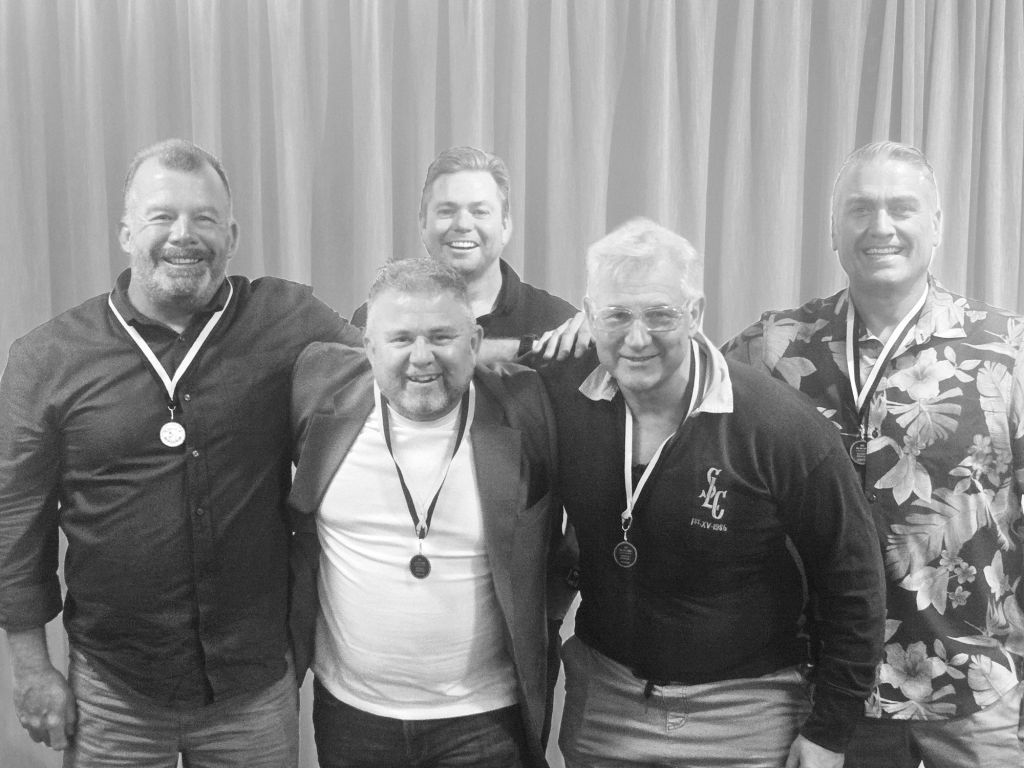
1986 1st XV members. Craig Smith, Matt Long, Chris Rea, Matthew Baker and Darren Nolan (R-L)CJ with Sean Stanley, Matthew Long, Craig Smith and Brendan Fitzpatrick.
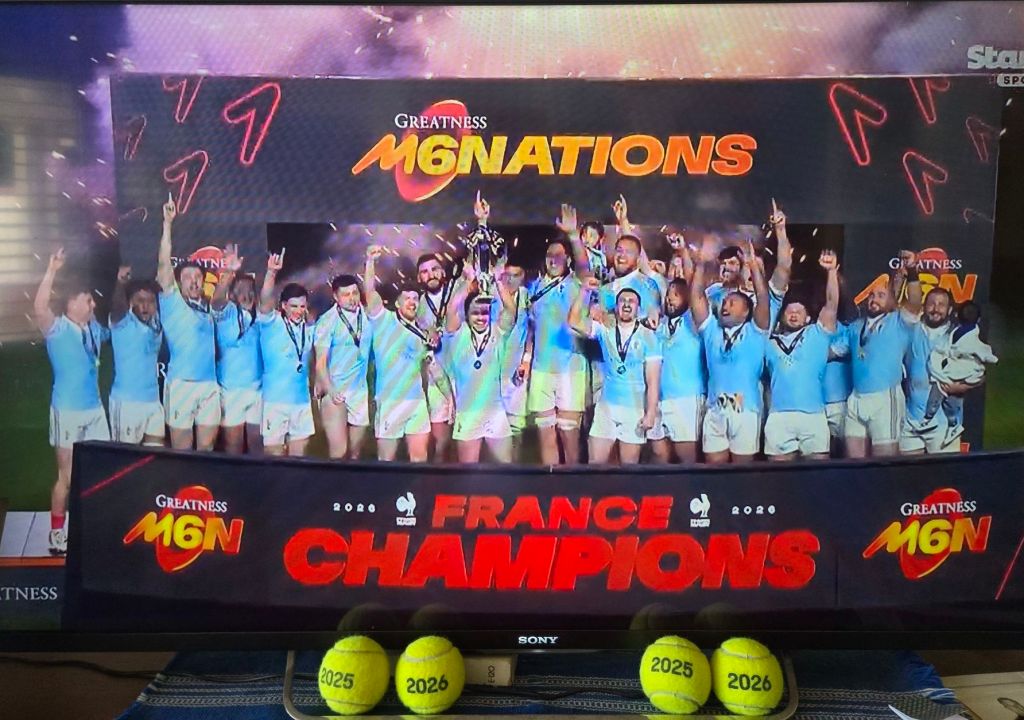
With round one of Premier Grade starting in Brisbane this weekend, we have already enjoyed a smorgasbord of top rugby from Paris to New York. France took out, back-to-back, 6 Nations at Stade de France, thanks to the boot of Thomas Ramos in injury time to defeat a spirited English side 48-46, that were coming off an 18-23 loss to Italy in Rome the week before.
6 Nations’ Champions 🏆 (photo courtesy of Stan Sports)
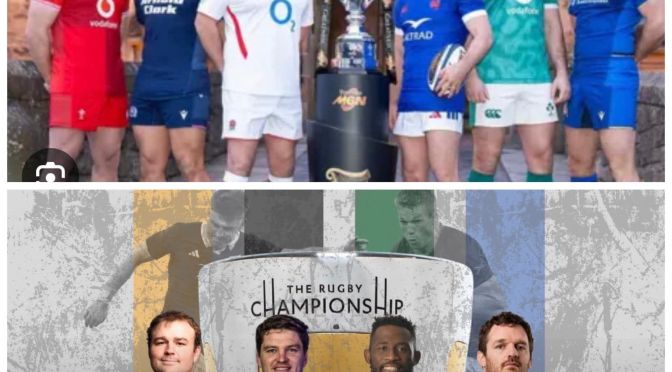
Ireland won the Triple Crown by beating the home nations, after they lost to France XV, 14-36, in the first round of the 2026 6 Nations Championship. Italy were the surprise packet, knocking off Scotland 18-15 and England 23-18, also at the Stadio Olimpico in Rome. Wales finally won their first 6 Nations match since 2023, overcoming Italy 31-17 at Millennium Stadium 🏟
Ahead of the 50th anniversary of the HSBC 7s in Hong Kong, the HSBC tournament moved to New York. The Blitzboks defeated Fiji 10-7 in extra time. The Kiwi women took out the Cup, 22-21, over their Southern Hemisphere nemesis, Australia. 🌏 Japan’s Sakura Sevens put in a credible showing; narrowly losing the payoff for 5th place to France 19-15.
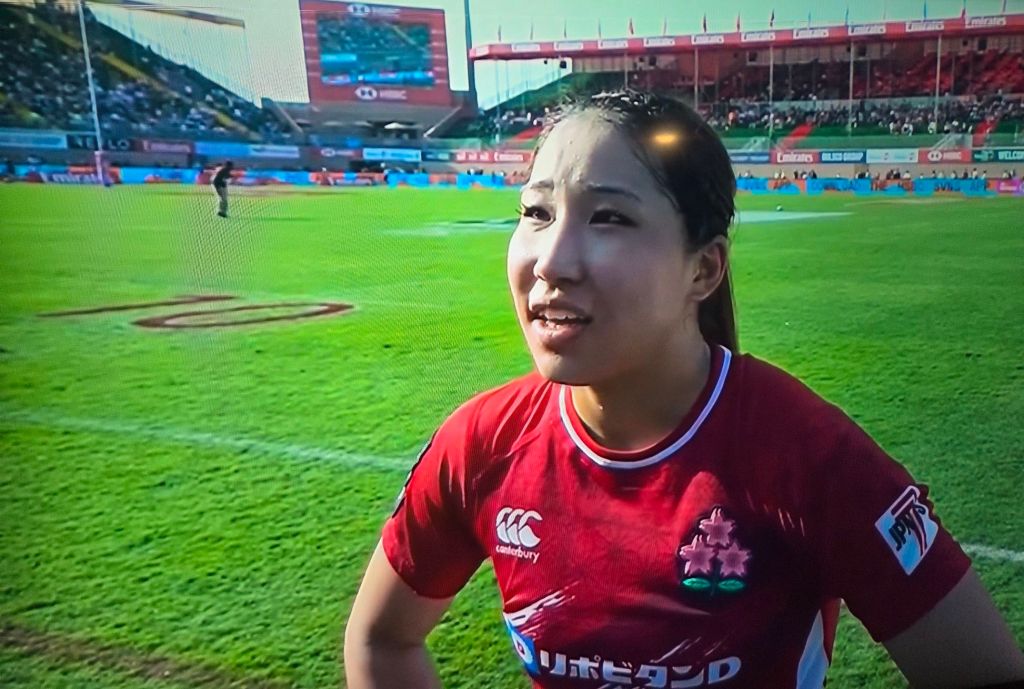
Sakura Sevens player, Ria Anoku. (Photo courtesy of Stan Sports)
The Super Rugby Pacific kicked off with the Aussie teams proving very competitive. The Brumbies defeated last year’s premiers, the Crusaders, in Christchurch 50-24; their first victory there since 2000. The Queensland Reds finally had a win, 21-6, over the Fijian Drua in Lautoka to register their first win in Fiji.
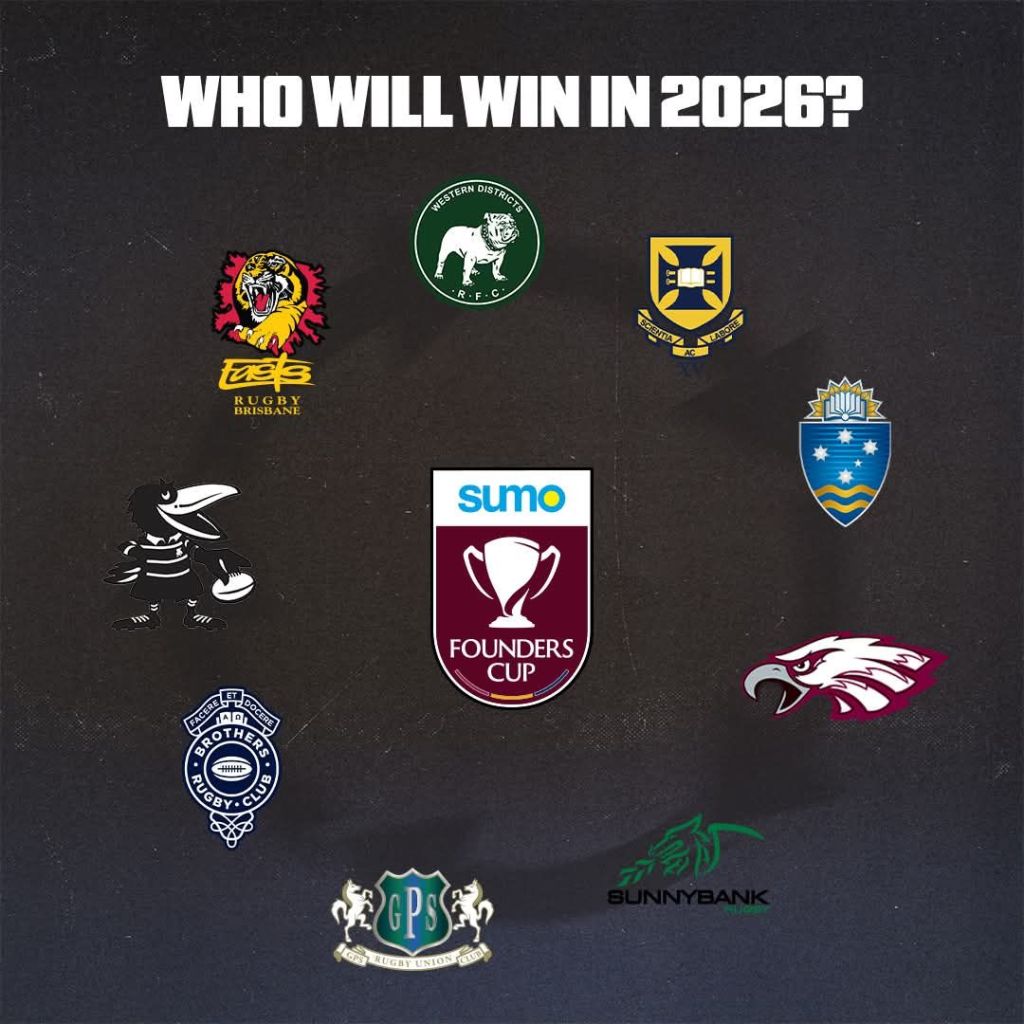
Premier Grade Rugby starts this weekend in Brisbane. Brothers are at home against Souths; Bond Uni plays UQ down the Coast; Easts play Wests at Bottomley Park; and Norths host Sunnybank.
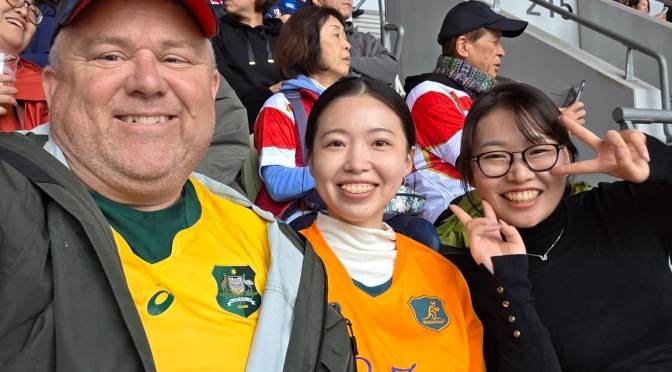
Earlier this year, when I saw that the Wallabies had a fixture against Eddie Jones’ Japanese side in Tokyo on the 25th of October, a plan was activated. It had been six years since my last visit for the RWC2019, and that was such a brilliant tournament, a testimony to the hospitality or “ometenashi” of the Japanese people. I booked a flight, organised accommodation and made an itinerary to maximise my time rediscovering a land where I lived for five years in my 20s.
Tokyo Olympic Stadium, or “kokuritsukyogijo”, was where the RWC2019 final was supposed to be played; however, due to oversight, the stadium wasn’t ready in time, and Yokohama Stadium was used instead. The stadium did host the delayed 2020 Olympics in 2021 (a great Trivial Pursuits question). A healthy crowd of 46,000 people sat comfortably in the cavernous 80,000-seat stadium while the match was played out on a rainy day in Tokyo. Joe Smidt’s experimental Wallaby side struggled to penetrate the well-drilled Brave Blossom’s side back under the tutelage of local hero, Eddie Jones. Wave after wave of forward runners were thwarted by the tenacious Japanese, and it was only a skilful interchange of passing that saw Josh Flook slip through for a try. The Aussies managed three tries in an underwhelming performance to start their spring tour to the Northern Hemisphere, only scraping home 19-15. The crowd favourite, Michael Leech, was immense, and his name was called out every time he touched the ball.
To say Japan is not a rugby-playing nation is a gross underestimation of her success. Following the ‘Miracle in Brighton’ at the 2015 Rugby World Cup, where the tenacious Brave Blossoms, under Eddie Jones, orchestrated one of the biggest upsets in not just rugby history, but all sports, where they took down the might Springboks in the dying seconds to win 34-32, saw a resurgence. Hosting the 2019 reiteration, they managed to beat Scotland and Ireland to claim top spot in their Pool and make the quarter finals for the first time.
Rugby union in Japan is a major part of the Japanese sporting landscape. While it may not catch the eyeballs of baseball or even the J-League soccer, it still has a rich history. A lot of Wallabies, Springboks and All Blacks ply their trade in Japan and get paid a healthy salary for their effort. We’ve seen the likes of Michael Hooper, one of the highest-paid Wallabies of late, have a sabbatical over there at the back end of his career. Noah Lolesio is over there now preparing for the League One, which starts shortly.
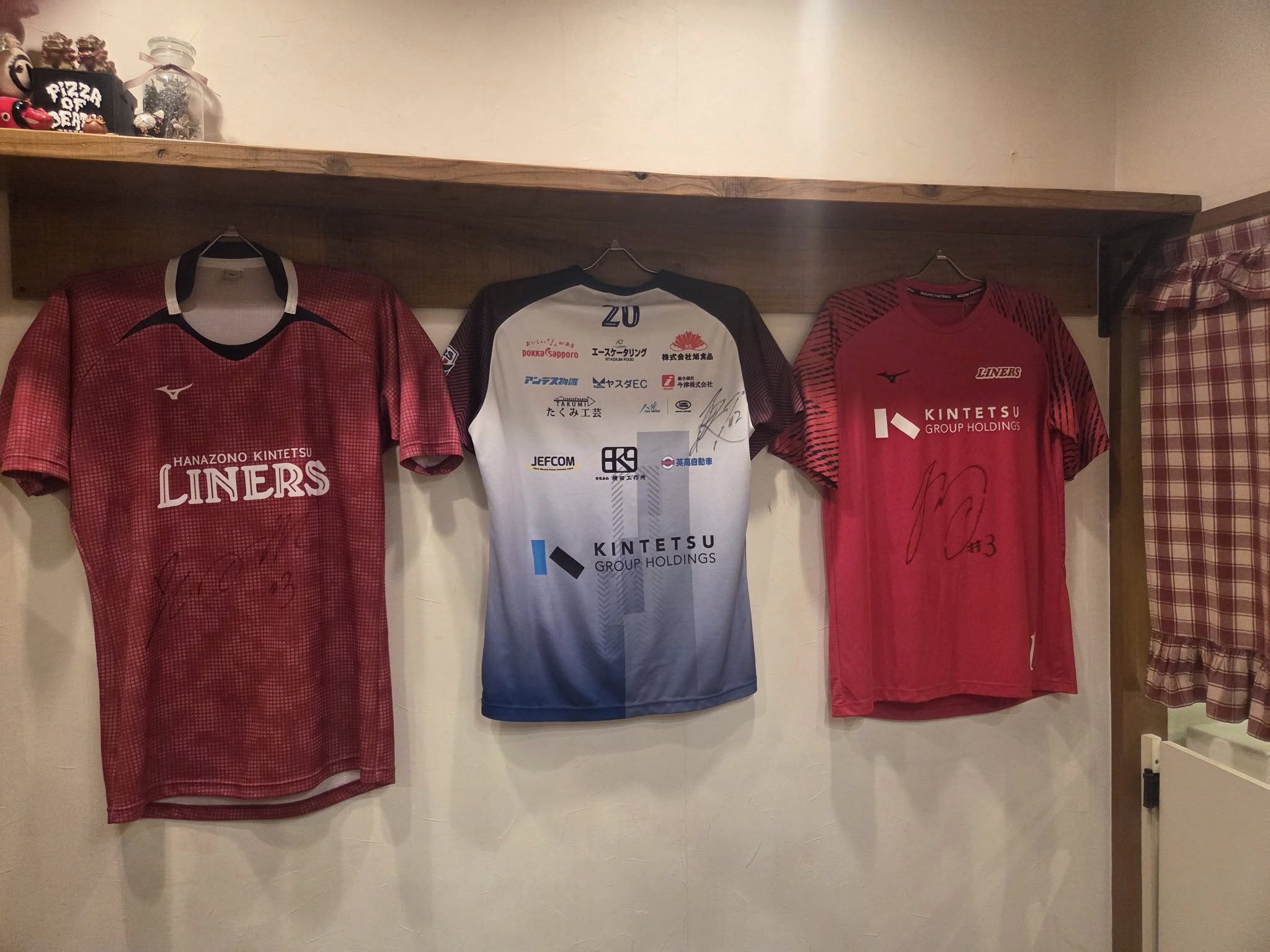
The Kansai region in western Japan is a fertile ground for rugby. The mighty Kobe Steelers have been a dominant force in Japanese rugby over the years. Wallaby legend Ian Williams played for them in the 1990s to great success, and of late, Dan Carter has led them to premierships. But it was in eastern Osaka where I found a rugby heartland at Hanazono, the Kintetsu Liners, coached by Will Genia and Quade Cooper, who had also played for them for several seasons.
To sum up my 17 days in the Land of the Rising Sun would be to say it was awesome. I had forgotten the generosity and hospitality of the Japanese people. Six years is just way too long. With Japan being part of the new Nations Cup of rugby, it will be sooner rather than later that I get back there.