With round one of Premier Grade starting in Brisbane this weekend, we have already enjoyed a smorgasbord of top rugby from Paris to New York. France took out, back-to-back, 6 Nations at Stade de France, thanks to the boot of Thomas Ramos in injury time to defeat a spirited English side 48-46, that were coming off an 18-23 loss to Italy in Rome the week before.
6 Nations’ Champions 🏆 (photo courtesy of Stan Sports)
Ireland won the Triple Crown by beating the home nations, after they lost to France XV, 14-36, in the first round of the 2026 6 Nations Championship. Italy were the surprise packet, knocking off Scotland 18-15 and England 23-18, also at the Stadio Olimpico in Rome. Wales finally won their first 6 Nations match since 2023, overcoming Italy 31-17 at Millennium Stadium 🏟
Ahead of the 50th anniversary of the HSBC 7s in Hong Kong, the HSBC tournament moved to New York. The Blitzboks defeated Fiji 10-7 in extra time. The Kiwi women took out the Cup, 22-21, over their Southern Hemisphere nemesis, Australia. 🌏 Japan’s Sakura Sevens put in a credible showing; narrowly losing the payoff for 5th place to France 19-15.
Sakura Sevens player, Ria Anoku. (Photo courtesy of Stan Sports)
The Super Rugby Pacific kicked off with the Aussie teams proving very competitive. The Brumbies defeated last year’s premiers, the Crusaders, in Christchurch 50-24; their first victory there since 2000. The Queensland Reds finally had a win, 21-6, over the Fijian Drua in Lautoka to register their first win in Fiji.
Premier Grade Rugby starts this weekend in Brisbane. Brothers are at home against Souths; Bond Uni plays UQ down the Coast; Easts play Wests at Bottomley Park; and Norths host Sunnybank.
I remember asking Tim Rowlands of Rugby Gold Coast, many years ago, who was an upcoming player I should watch. He was coaching Colts 1 at the time, and mentioned that a young prop from TSS, James Slipper, was going to go far; just how far we never knew! We at Brisbanerugby have been following his journey since then, through to the Reds, the Wallabies and now the Brumbies. Not only is he a legendary player, but a true gentleman off the field. One day up at Chipsy Wood in Yeronga, Brisbane, the Gold Coast Breakers were playing Souths. I don’t remember who won that day, but a young James Slipper came over to talk to my mum and me after being introduced by Tim Rowlands. So humble and so polite, Slips left an impression on my mother and me that we’ll never forget.
*”They had about six of these small cages, about a metre long & 40cm wide, each containing approximately six small dogs. They had defecated all over themselves throughout the entire journey, probably from Beijing -40 hours away. These dogs cried and yelped as they were rolled off the dock, end over end, onto three-wheeled bicycles –still in their cages– while the Chinese staff laughed. One English-speaking local said it was all right because some foreigners liked to eat them. (A poor justification for this barbaric treatment of these defenseless creatures).” Apparently, Deng Xiaping liked them for breakfast.
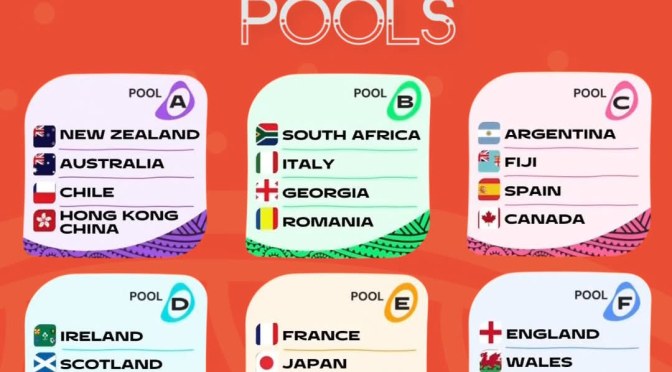
The Rugby World Cup draw took place last week, and the ‘big players’ have been dispersed across the Pools. The All Blacks and Wallabies meet for the first time in World Cup history in a round-robin match as the heavyweights of Pool A. South Africa and Italy headline Pool B; Argentina & Fiji in Pool C; Ireland & Scotland in Pool D; France & Japan in Pool E; and finally, England & Wales in Pool F. However, it is hard to go against the Springboks achieving a record fifth Webb-Ellis Trophy to make it three in a row under the leadership of Siya Kolisi.
Siya Kolisi addressed the media in Cardiff. Courtesy of Brisbanerugby.
According to the World Rugby rankings, the round of 16 would mean that the Top two finishers in the six Pools, plus the next four teams placed after the round-robin stage. The eight winners would progress to the knockout stage.
The opening match will be held in Perth, likely between the hosts, Australia and New Zealand, to a record sold-out crowd. This will mean that these two teams won’t meet again until the final in Sydney. The All Blacks will have to negotiate a tough semi-final against the Springboks, while the Wallabies will have to overcome a mighty English side.
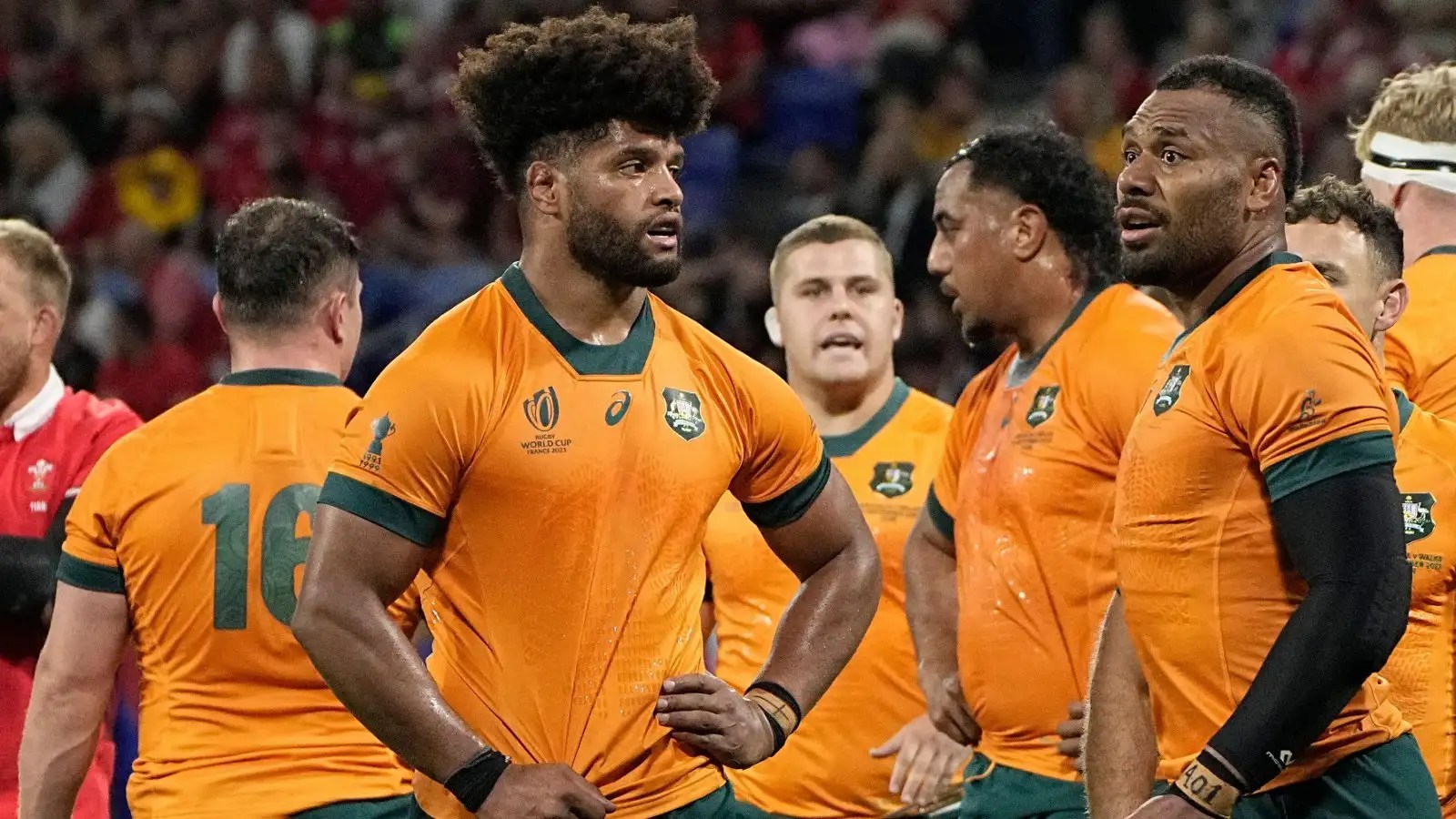
Wallabies in France at RWC 2023.
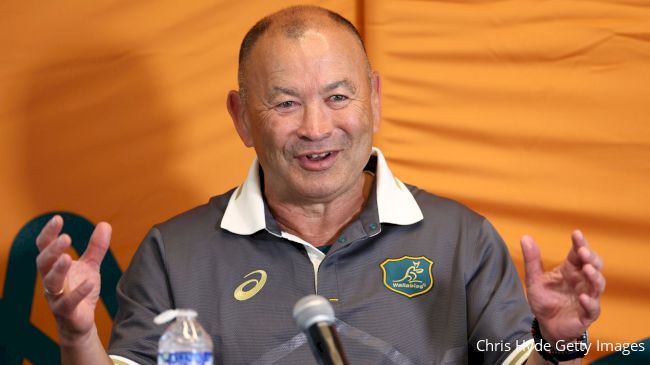
The Wallabies will have to play Japan in the quarter-final, a team they only managed to beat 19-15 at Tokyo’s Kokuritsugyogijo Stadium on October 25th this year. Eddie Jones’ men will be up for the challenge, possibly trying to replicate their RWC 2015 win over the Springboks in the Miracle in Brighton, arguably the greatest upset in not only Rugby World Cup history, but sport in general.
CJ in Tokyo at the Olympic Stadium. Courtesy of @brisbanerugby on Instagram
RWC 2027 is set up for the greatest contest in Rugby World Cup history, and the permutations will be studiously studied by the coaching staff of each participating nation, none more so than the mercurial Eddie Jones. Bring it on!!
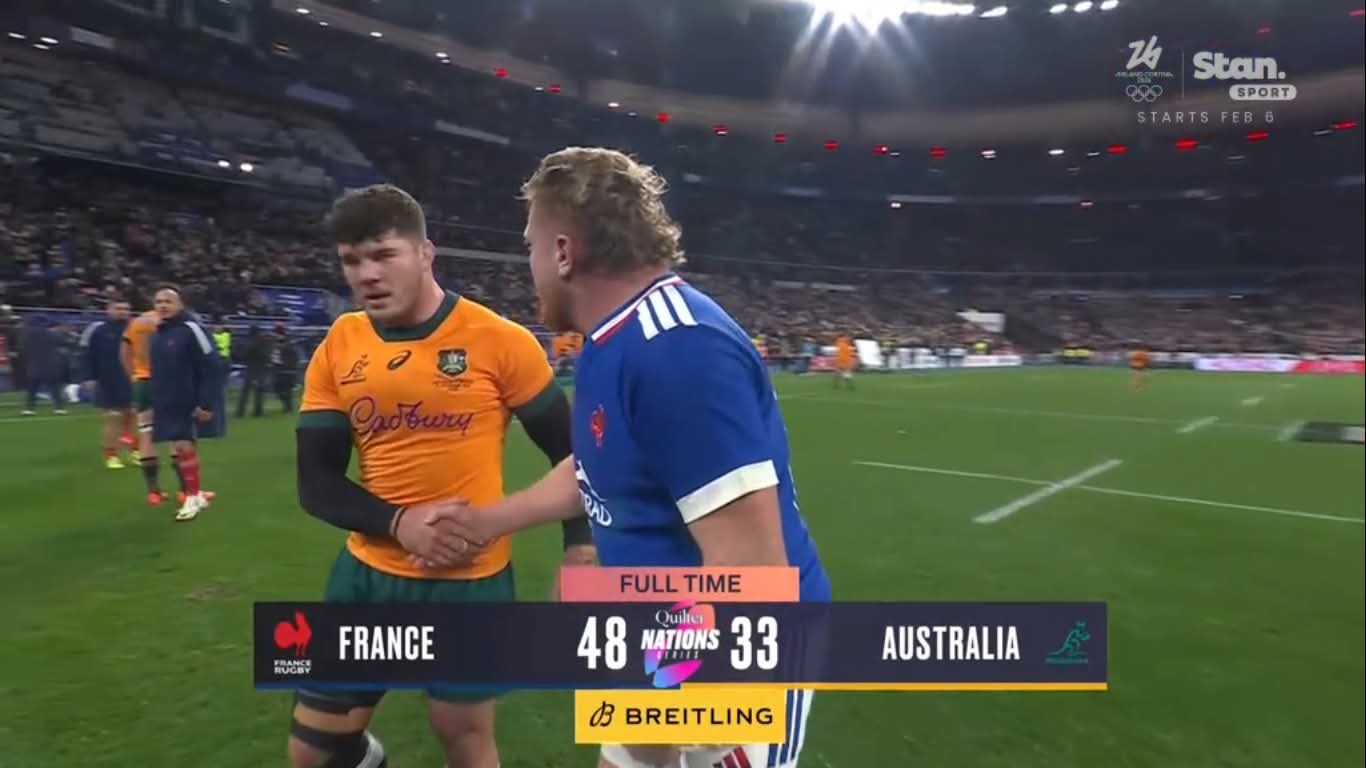
The Wallabies’ European vacation came to an end with a 48-33 loss to Les Bleus at Stad de France, just outside Paris in Saint-Denis. It capped off a season in which they won only five of their 15 tests, with memorable wins over the British and Irish Lions in Sydney and the mighty Springboks in Johannesburg.
With a 19-all half-time score, including a double by Queensland Red Matt Faessler, the Wallabies were right in it. In fact, they were only trailing by one point, 26-27, at the hour mark before conceding three converted tries to go down by 15. A much-improved outing by Joe Schmidt’s men before Tom Hooper received a Yellow Card in the 65th minute, and the penalty count was mounting, 10 in the second half. John Eales Medalist Len Ikitau was the standout, with 15 carries. Angus Bell was immense, scoring a breakaway try in his 50th test, and Josh Nasser went over on debut. Also, congratulations to Queensland Reds’ halfback, Kalani Thomas, on making his Wallabies debut.
Their European campaign started off at Twickenham with a bruising 25-7 loss to England, followed by a loss to Italy, 26-19; ironically, all 5 tries were scored by Australians. Unfortunately, Luis Lynaugh and Monty Ioana were wearing the blue of Italy. They moved to Dublin, where it all unravelled, despite the in-and-out-again James O’Connor trying his best to go down to 3rd ranked Ireland 46-19. Against France, they showed attacking flair with Matt Faessler bagging a double and his front row partner, Angus Bell, crossing the paint in the first half to have it all locked up 19-all at the break. World Rugby player of the year nominee, Louis Bielle-Biarrey, broke the Aussies’ spirit with a brilliant individual try in the first half and helped, Man of the Match, Nicolas Depoortere to a double. Fabien Galthie’s men were too strong in the end to smash the Wallabies
It is the first time since 1958 that the Wallabies have gone winless on the European tour. However, technically, they did beat a spirited Eddie Jones-orchestrated Japanese outfit, 19-15, in Tokyo on the first leg of the Spring Tour.
Earlier this year, when I saw that the Wallabies had a fixture against Eddie Jones’ Japanese side in Tokyo on the 25th of October, a plan was activated. It had been six years since my last visit for the RWC2019, and that was such a brilliant tournament, a testimony to the hospitality or “ometenashi” of the Japanese people. I booked a flight, organised accommodation and made an itinerary to maximise my time rediscovering a land where I lived for five years in my 20s.
Tokyo Olympic Stadium, or “kokuritsukyogijo”, was where the RWC2019 final was supposed to be played; however, due to oversight, the stadium wasn’t ready in time, and Yokohama Stadium was used instead. The stadium did host the delayed 2020 Olympics in 2021 (a great Trivial Pursuits question). A healthy crowd of 46,000 people sat comfortably in the cavernous 80,000-seat stadium while the match was played out on a rainy day in Tokyo. Joe Smidt’s experimental Wallaby side struggled to penetrate the well-drilled Brave Blossom’s side back under the tutelage of local hero, Eddie Jones. Wave after wave of forward runners were thwarted by the tenacious Japanese, and it was only a skilful interchange of passing that saw Josh Flook slip through for a try. The Aussies managed three tries in an underwhelming performance to start their spring tour to the Northern Hemisphere, only scraping home 19-15. The crowd favourite, Michael Leech, was immense, and his name was called out every time he touched the ball.
To say Japan is not a rugby-playing nation is a gross underestimation of her success. Following the ‘Miracle in Brighton’ at the 2015 Rugby World Cup, where the tenacious Brave Blossoms, under Eddie Jones, orchestrated one of the biggest upsets in not just rugby history, but all sports, where they took down the might Springboks in the dying seconds to win 34-32, saw a resurgence. Hosting the 2019 reiteration, they managed to beat Scotland and Ireland to claim top spot in their Pool and make the quarter finals for the first time.
Rugby union in Japan is a major part of the Japanese sporting landscape. While it may not catch the eyeballs of baseball or even the J-League soccer, it still has a rich history. A lot of Wallabies, Springboks and All Blacks ply their trade in Japan and get paid a healthy salary for their effort. We’ve seen the likes of Michael Hooper, one of the highest-paid Wallabies of late, have a sabbatical over there at the back end of his career. Noah Lolesio is over there now preparing for the League One, which starts shortly.
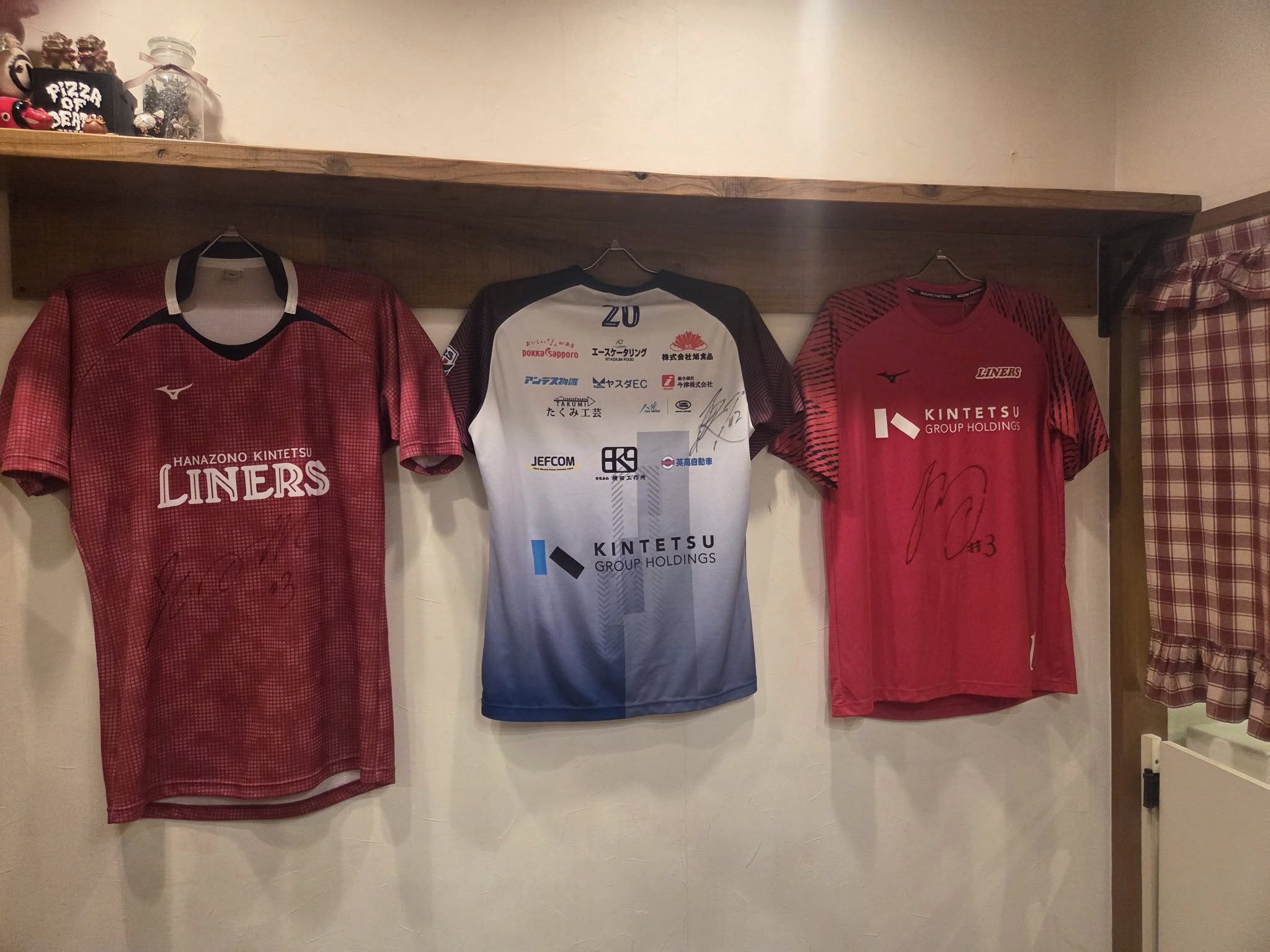
The Kansai region in western Japan is a fertile ground for rugby. The mighty Kobe Steelers have been a dominant force in Japanese rugby over the years. Wallaby legend Ian Williams played for them in the 1990s to great success, and of late, Dan Carter has led them to premierships. But it was in eastern Osaka where I found a rugby heartland at Hanazono, the Kintetsu Liners, coached by Will Genia and Quade Cooper, who had also played for them for several seasons.
To sum up my 17 days in the Land of the Rising Sun would be to say it was awesome. I had forgotten the generosity and hospitality of the Japanese people. Six years is just way too long. With Japan being part of the new Nations Cup of rugby, it will be sooner rather than later that I get back there.
Licking their wounds from a first-up, 24-28, loss to Los Pumas in Dublin, the British and Irish Lions are finally on our shores. Touching down at Perth International Airport late Sunday, the entity founded in 1888 is once again in Australia after a 12-year absence.
First up, they tackle a Wallaby-laden Western Force at Optus Stadium on Saturday, as part of their 9-match tour. They play all the Australian Super Rugby Pacific provinces, plus an Aus/NZ combined match and an Indigenous/Pasifika match, culminating in three test matches against the Wallabies.
What separates Rugby Union from other codes is its deep historical tapestry, of which a British and Irish Lions tour is part of that fabric. Only gathering every four years, they alternate their tours between New Zealand, South Africa and Australia. Dating back to 1888, a squad made up of players from England, Scotland and Wales toured Australia and New Zealand, playing provincial games without any international test matches.
The last time they toured was to South Africa in 2021 during COVID. They played in empty stadiums and lost the series 1-2. This time, their fans are coming in great numbers, having been deprived of a tour for 8 years, since the drawn series against New Zealand in 2017. Twelve years ago, the British and Irish Lions won the series against Australia 2-1, a first since 1989, though they did lose to the Brumbies 12-14 en route to the test matches.
So strap yourself in for six weeks of intense rugby that has not been seen on our shores for a long time. May the best teams win.
As the Wallabies are about to embark on their spring tour to the British Isles and Ireland, we should assess where they are at. Coming off four wins from their nine matches this season, and being ranked 10th in the world, they are not in anyway achieving success.
Two wins over a weak, developing Welsh side and a shaky win over Georgia to start Joe Schimdt’s tenure has barely been a pass mark. Then, despite some positive aspects, going down to the world-champion Springbok outfit in two tests at home proved that there is still plenty of work to do with this team. A narrow one-point victory over Argentina followed by a massive 67-27 loss the following week exposed this side’s deficiencies.
Rounding out The Rugby Championship with a loss at home to the All Blacks and a week later losing in Wellington did not do the Wallabies any favours. Leaving Schmidt with only four wins from nine outings and the lowest ranking of 10th in the world provides plenty of homework for him ahead of the spring tour.
It hasn’t been all doom and gloom, though, with a wealth of talent exposed with 16 debutants given a chance. Carlo Tizzano was a standout coming in for the injured Fraser McReight and Dylan Pietsch showed he is up to world standard, particularly in his first run-on test in Wellington. Rob Valetini was a menace alongside Harry Wilson and McReight; and Taniela Tupou showed how tough he is but is barely getting through 40 minutes.
However, if the Wallabies are going to have any impact at next year’s British and Irish Lions tour, they are going to have to show plenty of improvement. The spring tour provides that opportunity. Bringing in overseas-based players such as Will Skelton does just that. Also, Quade Cooper or Bernard Foley to provide some guidance for Noah Lolesio, Ben Donaldson and Tom Lynagh. Even from left field picking one of Brisbanerugby’s top sons, Isaac Lucas, who is killing it in Japan, could be another solution for the lacklustre display at number 10.
CJ & Isaac Lucas courtesy of @brisbanerugby on Instagram
So the 2023 Rugby World Cup has been decided in Paris by one point between two giants of the rugby world in South Africa and New Zealand. As the rain came down at Saint-Denis the Springboks went about their business of acquiring points through the boot of Handre Pollard to be up 12-6 at half-time. The only points in the second half was an unconverted try by Beauden Barrett that left the All Blacks one short at the end to lose by the slimmest of margins, 11-12.
After seven weeks of intense battle, the two teams that had each won the tournament three times a piece, were left to fight the final battle. The Northern Hemisphere had said that the Southern Hemisphere were not up to standard, but some performances of Fiji and Argentina, in particular, were worth taking note of. Despite this, Australia performed badly losing to Fiji for the first time in 69 years and being thumped by Wales 40-6 in the Pool stages which meant they could not reach the knockout stages for the first time in World Cup history. A lot of the blame can be laid on the coach, Eddie Jones, for not preparing his young team to do better. As a consequence, he has resigned from his position.
However, the final came down to two teams that had lost one match each in their respective Pool matches. New Zealand lost to France, 13-27, and South Africa lost to Ireland, 8-13. Ironically, those matches were reversed in the quarter-finals where New Zealand defeated Ireland, 28-24, and South Africa defeated France, 29-28. While the All Blacks had an easy route over Los Pumas, 44-6, in the semi-final the Springboks did it much harder against a determined English side to win by a single point, 16-15.
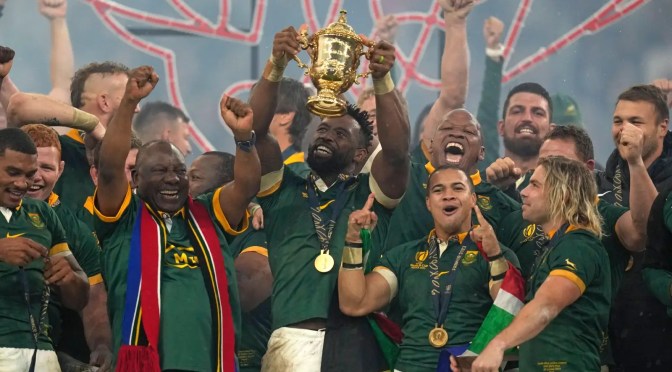
It is a true testament that the Springbok team could galvanise under Siya Kolisi to win a fourth Webb-Ellis trophy, back-to-back champions. And not just the team as Kolisi says, “Our country goes through such a lot and we are that very hope that they have”. They had plenty of support in the crowd as well, none more so than tennis great Roger Federer whose mother is South African. Well done!
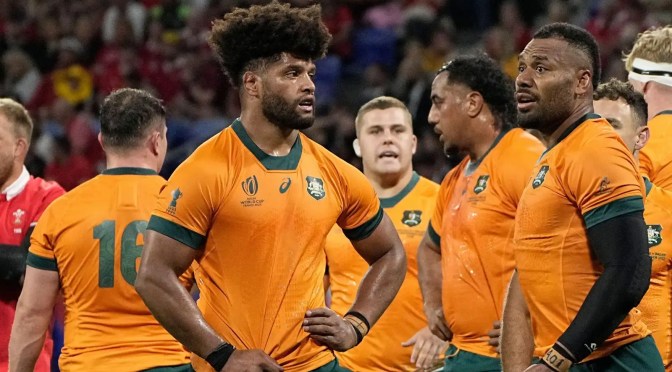
The ancient Roman city of Lugdunum (modern day Lyon) was where the Australian Wallabies met their Waterloo. And just as many martyrs have died in the various colisseums scattered throughout the city, the wounded Wallabies join this pile. Coming into the match against Wales they had suffered their first defeat in 69 years, 15-22, at the hands of their South Pacific cousins, Fiji. Being put to the sword with a 40-6 thumping by the Welsh, Australian rugby is at an all-time low and staring down the possibility of not getting out of their Pool for the first time in World Cup history.
The recriminations against their coach, the talismanic Eddie Jones, have already began with quarter-final positions not yet decided. If he did take a call from the Japanese Rugby Football Union (JRFU), to which he strongly denied, before the World Cup then the distractions before the important Wales match can be justified; if not then a really bad look from the Australian media. Rugby is based more and more around the coach’s instructions and if that trust is lost the team can become disorientated. This certainly looked the case when Samu Kerevi seemed to be the only Wallaby making any penetration in the first half when they had plenty of possession. Nothing they tried seemed to come to fruition and the Welsh defence was more than adequate to the task and kept the scoreboard ticking over every time they were down Australia’s end. Down 16-6 at half-time the Aussies were still in the fight, but poor judgement let them down and a masterclass by Gareth Anscombe meant the men from Gaul would be deserved victors in Lyon.
Many Wallaby fans had travelled over for the match but became disillusioned early when Gareth Davies scored in the 3rd minute and was subsequently converted by Dan Biggar. Biggar was substituted in the 12th minute by Gareth Anscombe who manged to knock over three penalties after missing the first to make the score 16-6 at the break.
CJ with Wallaby fan before the match.
The second half began as the first finished with an Anscombe penalty. By the time Nick Tompkins scored in the 48th minute the Wallaby supporters became subdued and the Welsh singing began to pick up. It was not a happy night to be wearing Green and Gold. The final score of 40-6 was a knife to the heart of diehard Wallaby fans and the possibility that they might night continue to the quarters unfathomable.
















 Brisbane Rugby.com