With round one of Premier Grade starting in Brisbane this weekend, we have already enjoyed a smorgasbord of top rugby from Paris to New York. France took out, back-to-back, 6 Nations at Stade de France, thanks to the boot of Thomas Ramos in injury time to defeat a spirited English side 48-46, that were coming off an 18-23 loss to Italy in Rome the week before.
6 Nations’ Champions 🏆 (photo courtesy of Stan Sports)
Ireland won the Triple Crown by beating the home nations, after they lost to France XV, 14-36, in the first round of the 2026 6 Nations Championship. Italy were the surprise packet, knocking off Scotland 18-15 and England 23-18, also at the Stadio Olimpico in Rome. Wales finally won their first 6 Nations match since 2023, overcoming Italy 31-17 at Millennium Stadium 🏟
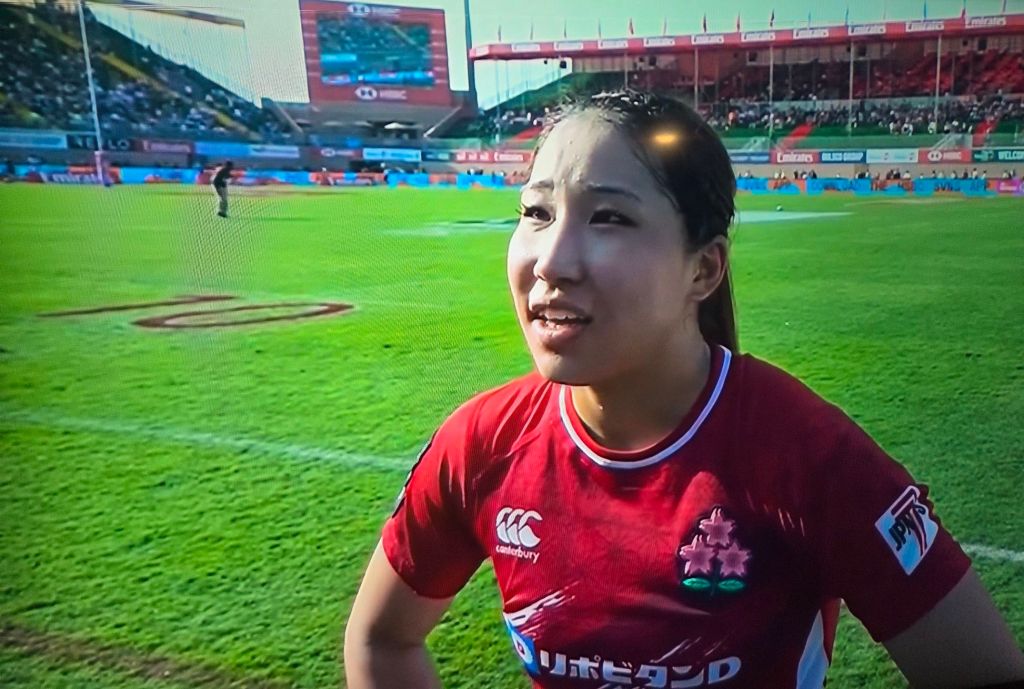
Ahead of the 50th anniversary of the HSBC 7s in Hong Kong, the HSBC tournament moved to New York. The Blitzboks defeated Fiji 10-7 in extra time. The Kiwi women took out the Cup, 22-21, over their Southern Hemisphere nemesis, Australia. 🌏 Japan’s Sakura Sevens put in a credible showing; narrowly losing the payoff for 5th place to France 19-15.
Sakura Sevens player, Ria Anoku. (Photo courtesy of Stan Sports)
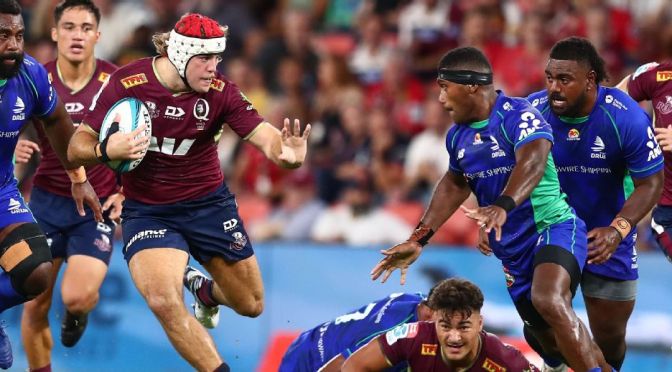
The Super Rugby Pacific kicked off with the Aussie teams proving very competitive. The Brumbies defeated last year’s premiers, the Crusaders, in Christchurch 50-24; their first victory there since 2000. The Queensland Reds finally had a win, 21-6, over the Fijian Drua in Lautoka to register their first win in Fiji.
Premier Grade Rugby starts this weekend in Brisbane. Brothers are at home against Souths; Bond Uni plays UQ down the Coast; Easts play Wests at Bottomley Park; and Norths host Sunnybank.
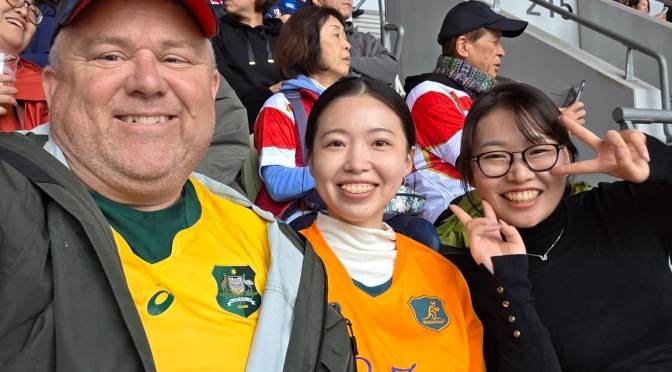
Earlier this year, when I saw that the Wallabies had a fixture against Eddie Jones’ Japanese side in Tokyo on the 25th of October, a plan was activated. It had been six years since my last visit for the RWC2019, and that was such a brilliant tournament, a testimony to the hospitality or “ometenashi” of the Japanese people. I booked a flight, organised accommodation and made an itinerary to maximise my time rediscovering a land where I lived for five years in my 20s.
Tokyo Olympic Stadium, or “kokuritsukyogijo”, was where the RWC2019 final was supposed to be played; however, due to oversight, the stadium wasn’t ready in time, and Yokohama Stadium was used instead. The stadium did host the delayed 2020 Olympics in 2021 (a great Trivial Pursuits question). A healthy crowd of 46,000 people sat comfortably in the cavernous 80,000-seat stadium while the match was played out on a rainy day in Tokyo. Joe Smidt’s experimental Wallaby side struggled to penetrate the well-drilled Brave Blossom’s side back under the tutelage of local hero, Eddie Jones. Wave after wave of forward runners were thwarted by the tenacious Japanese, and it was only a skilful interchange of passing that saw Josh Flook slip through for a try. The Aussies managed three tries in an underwhelming performance to start their spring tour to the Northern Hemisphere, only scraping home 19-15. The crowd favourite, Michael Leech, was immense, and his name was called out every time he touched the ball.
To say Japan is not a rugby-playing nation is a gross underestimation of her success. Following the ‘Miracle in Brighton’ at the 2015 Rugby World Cup, where the tenacious Brave Blossoms, under Eddie Jones, orchestrated one of the biggest upsets in not just rugby history, but all sports, where they took down the might Springboks in the dying seconds to win 34-32, saw a resurgence. Hosting the 2019 reiteration, they managed to beat Scotland and Ireland to claim top spot in their Pool and make the quarter finals for the first time.
Rugby union in Japan is a major part of the Japanese sporting landscape. While it may not catch the eyeballs of baseball or even the J-League soccer, it still has a rich history. A lot of Wallabies, Springboks and All Blacks ply their trade in Japan and get paid a healthy salary for their effort. We’ve seen the likes of Michael Hooper, one of the highest-paid Wallabies of late, have a sabbatical over there at the back end of his career. Noah Lolesio is over there now preparing for the League One, which starts shortly.
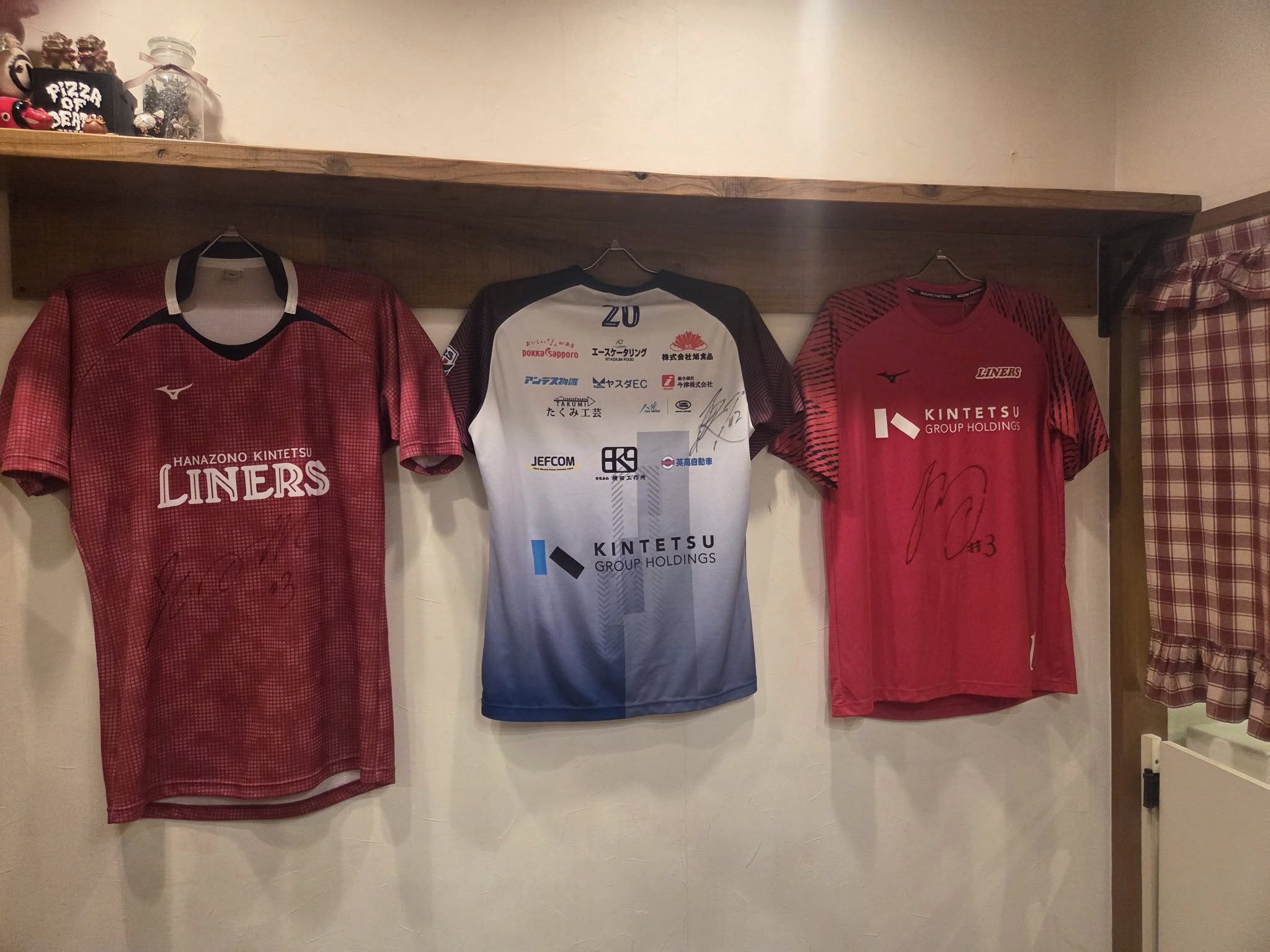
The Kansai region in western Japan is a fertile ground for rugby. The mighty Kobe Steelers have been a dominant force in Japanese rugby over the years. Wallaby legend Ian Williams played for them in the 1990s to great success, and of late, Dan Carter has led them to premierships. But it was in eastern Osaka where I found a rugby heartland at Hanazono, the Kintetsu Liners, coached by Will Genia and Quade Cooper, who had also played for them for several seasons.
To sum up my 17 days in the Land of the Rising Sun would be to say it was awesome. I had forgotten the generosity and hospitality of the Japanese people. Six years is just way too long. With Japan being part of the new Nations Cup of rugby, it will be sooner rather than later that I get back there.
Heading in to Round 5 of Super Rugby Pacific, only the Brumbies and the Reds remain undefeated. They face off against each other this Friday in Canberra to see which team remains undefeated for the 2022 season. The matchup between Tom Banks and Jordan Petaia at fullback will be interesting ahead of Wallaby selection. Petaia played a great game there for the Reds in his first chance to run on with the 15 jersey. Both in attack and defence he imposed himself as a real contender for the Wallaby role there.
Petaia’s try saving tackle courtesy of Super Rugby Pacific
An injury ravaged Reds held out Fijian Drua at the weekend, ironically, it was a Fijian in Seru Uru that saved the Reds from an embarrassing result. Up four tries to nil with 15 minutes to go it looked like the Reds were heading for a bonus point victory until the visitors scored three unanswered tries in quick succession. With less than 10 minutes remaining on the clock the scores were locked at 28-all before Uru reached over from a maul to score a five-pointer taking the score to 33-28 to the Reds. That is not where the drama ended as Uru stole a lineout off the Fijians on the Queensland line at the fulltime mark to deny them drawing level or even winning.
Coach Brad Thorn said, “For our team, a game like that can be a challenge because there’s space and there’s opportunities but you’ve almost got to rein it in a little bit.
“Keep your patience, don’t overplay – that’s probably how I would assess that.”
BRISBANE, AUSTRALIA – MARCH 12: Seru Uru of the Reds runs the ball during the round four Super Rugby Pacific match between the Queensland Reds and the Fijian Drua at Suncorp Stadium on March 12, 2022 in Brisbane, Australia. (Photo by Chris Hyde/Getty Images)
Uru’s (pictured above) standout performance has made Thorn’s job a little bit harder this week with the expected return of captain Liam Wright in the position Uru was playing. It’s really a good headache to have knowing that the Reds have depth and that the guys will really put in for each other when their chance comes. That depth will be really tested on Friday when they come up against the Brumbies that are also in red hot form.
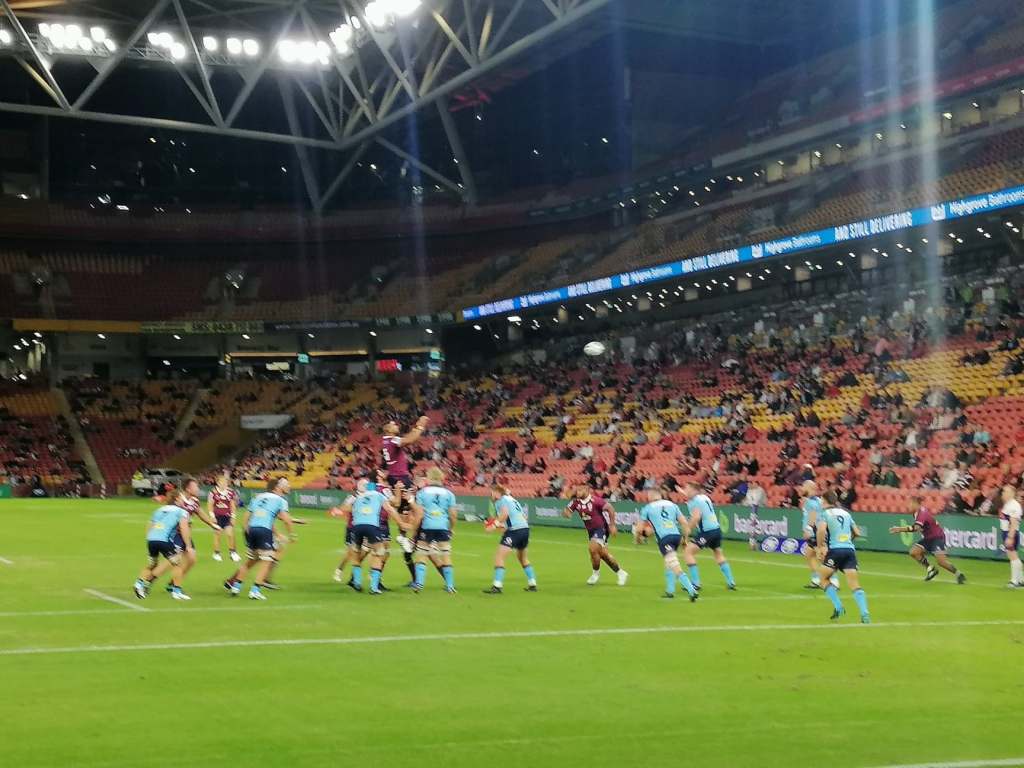
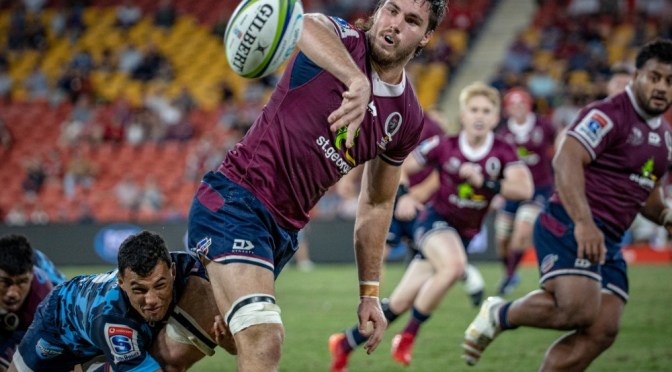
The Queensland Reds have finally broken an 11 match hoodoo! After 7 long years, they have nailed arch interstate rivals the New South Wales Waratahs with a 32-26 victory at Suncorp Stadium.
In front of a sparse crowd, due to COVID-19 restrictions, the Reds were out of the blocks early with their fearless leader, Liam Wright, going over in the sixth minute. Though, this was short lived when the ‘Tahs prop, Harry Johnson-Holmes, scrambled over the line in the tenth minute to level the score 7-all. A bruising affair ensued as the Reds scrum & line-out dominated resulting in two more tries for the home side to lead 19-7. However, last year’s Junior Wallabies’ No. 10, Will Harrison, slotted two penalties in the last six minutes before halftime to go to the sheds only 6 behind at 19-13.
Reds had a dominate line-out
Reds are in again
Photos courtesy of GTR (top photo from Brendan Hertel)
Harrison’s sharp shooting landed another penalty goal early in the second half followed by Jack Maddocks slicing through a gap off the ruck to score under the posts. The visitors were now leading 23-19 only 8 minutes in.
A try to another 2019 Junior Wallaby, No.8 Harry Wilson, in the 64th minute that was converted had the Reds back in the lead at 26-23. Only three minutes later the Harrison boot equaled the score before the confident boot of James O’Conner took over, from an indifferent kicking display from Bryce Hegarty, to put the match out of reach with two penalties at the 75th & 80th minute mark to break the 26-all deadlock.
A fairly even match with the Reds having 57% of possession, 58% of territory and scoring four tries to two making them the deserved winners in a tough State verse State, mate against mate encounter.
James O’Conner said after the match: “It was an awesome effort by the guys. We dug deep and obviously winning it right at the end was amazing.”
Though he admitted: “We were pretty scrappy… There’s a lot to improve on.”
Special mention for debutante Tuaina Tualima coming on early in the first half for Angus Blyth. He definitely will benefit for the hour+ he had on the paddock.
What was billed as a double header with four nations involved turned out to be a fizzer due to coronavirus with a paltry 7335 swallowed by the cavernous 52,000-seat Suncorp Stadium. Not that the action on the field suffered. With the tenacious Sunwolves holding out the mighty crusaders in the first half nearly going to the break 7-all. It was only basic errors up against a far superior opponent that meant that the scoreline got away to14-49 loss, despite their numerical advantage of two players at the death. Jake Shatz said he was proud of the way his boys stuck it to the more fancied Kiwis and as the Japanese coach, Naoya Okubo, told me after the match that the camaraderie amongst his squad being away from their Tokyo base for so long has been great. Of course, having a few local Aussie members has helped and there has been no shortage of local clubs bending over backwards to provide training pitches non gratis.
The Reds, unaffected by the lower then normal turnout, proved my early assessment correct that this cohort will go places. Down 0-17 they dug deep to show the faithful that their 4-try haul against the Crusaders last week could be backed up scoring 41 unanswered points to win 41-17. Captain courageous, Liam Wright (picture courtesy of Brendan Hertel QRU), has put Michael Hooper on notice that his cushy multi-million dollar contract might mean he can purchase more houses on Sydney’s North Shore but he doesn’t haven’t a mortgage on the Wallabies position.
Another massive performance from Lukan Salakai-Loto, who told me after the match he prefers No. 6 for the Wallabies, and BrisbaneRugby favourite son Isaac Lucus added to the positives from this match ahead of Super Rugby going into a hiatus. And when live-wire halfback Tate McDermott came on the team lifted another notch.
The nomadic Sunwolves should make the Sunshine State their home base in their final Super Rugby season, moreover Townsville in the north with a new 25,000-seat stadium. It would be a win-win for all parties concerned starting with their match against the Reds on April 5. The north has been crying out for a Super Rugby match, something they haven’t experienced since 2006 and, as I reported last year, there is a healthy following of rugby union up there: https://brisbanerugby.com/2019/07/09/rugby-in-the-regions/.
With the onset of coronavirus tourism has had a huge setback and I’m sure Tourism & Events Minister, Kate Jones, would bend over backwards to help the Japanese team out. The extra Japanese eyeballs on the area would be welcome, especially if they played out the rest of their ‘home’ games there and their Tokyo supporters made there way to Tropical Queensland.
Honorable Member for Ashgrove, Kate Jones. Photo courtsy of The Courier Mail.
The Sunwolves are like ronin, or masterless samurai, although they are a motley crew of ex-pat Aussie, Kiwis, South Africans and some Japanese they do have some local Queensland representatives, such as captain Jake Shatz, to build some domestic support behind moving forward especially if they evolve into a team in Global Rapid Rugby next season. I know Tim Horan’s son Alex, who debuted for the Sunwolves two weeks ago in New Zealand, has two compatriots in Townsville at James Cook University that played Colts with him in Brisbane that would be getting behind the side.
If reports out of France are true it’s au voire to Kurtley Beale as they will pay for his retirement through French Club Racing 92. Good riddance I’d say as he’s well past his use-by date, costing us a semifinal berth at RWC2019 last year. I know he had to go along to Cheika’s Waratahs swansong in Japan as reward for winning the Super Rugby title in 2014; though when is enough enough? I still remember how he lined up for that unmissable final kick at Lang Park in 2013 to defeat the British & Irish Lions in Game 1; what a disgrace. He may have slotted that 50m+ bomb at Loftus to break a Wallaby drought of wins on the high veldt, but that British & Irish Lions debacle was a bridge too far. Giving him the captaincy at the weekend didn’t change a thing, Kurtley is still Kurtley Beale; when he’s good he’s very very good, but when he’s bad he’s awful.
I said it before, and I’ll say it again. “There’s a lot to like about the Reds of 2020”. With James O’Conner nursing an ankle injury, Brad Thorn gave BrisbaneRugby favourite son, Izaac Lukus (pictured with CJ), a licence to thrill in the No. 10 jersey and he didn’t disappoint. Up against All Black pivot Richie Mo’unga he was not afraid to take on the champion defence. The most successful team in the 25 years of Super Rugby were unsure of how to take the young Queenslanders; they even looked rattled in attack. Thorn knows how well they prepare at home, being a past Crusaders player himself, so he would have been delighted with the narrow loss. My daughter even noted the 20-24 loss saying that the Reds must have been ‘aweful’ and I informed her that the Reds actually scored 4 tries to 3; leaving 8 points on the field.
Along with my Souths Rugby Club compatriot, Andrew Slack, I was equally concerned why the rotation policy had meant that live-wire halfback, Tate McDermott. wasn’t in the run-on 15 for this must win clash. They opted for Samoan halfback, Scott Malolua to have over an hour of game time. Admittedly, Lukan Salakai-Loto showed his rest from the starting 15 last week earned him Green & Gold MOM this week.
Timely return to Ballymore for English kicking guru, Dave Alred. The Kiwis can, South Africa can. How good would it be to have a Leigh Halfpenny, a Dan Bigger or even Owen Farrell all banging over 100% at Twickenham over the weekend in their Round Four clash. Three tries a piece but the scoreline read England 33-30 over Wales. It’s what makes the Guinness Six Nations so attractive to corporate sponsorship. Game management by England was key to their weekend win and another Triple Crown. Raelene Castle should be checking Eddie Jones’ contractual arrangements, to try to get him back in time for France 2023 World Cup. (Full report of Six Nations RD #4: https://wordpress.com/read/feeds/77206314/posts/2617244225)
With Andrew Twiggy Forrest’s Global Rapid Rugby speeding up the game with shorter halves. Alan Jones wrote in The Australian on Friday about extending the time, allegedly to account for ‘time wasting’ with scrums. As with The Australian’s Rugby Editor, Wayne Smith, I too was intrigued by the novel concept of extending the halves by 5 minutes to match football, ie. soccer.
Aussie 7s in Vancouver were unlucky to go down 14-17 to the NZ 7s in the HSBC Sevens Series Cup final. Aussie 7s haven’t beaten the Kiwis in a 7s final since Brisbane 2002.
There’s a lot to like about this 2020 Reds side despite only one win from six outings. Easing Brisbanerugby favourite Izaac Lukus back into the starting pivot as James O’Conner sits out this week with the ankle injury he sustained in last weeks loss to the Sharks at Lang Park. I like what Brad Thorn is doing over at Ballymore resting his chargers, such as livewire halfback Tate McDermott coming off the pine today in Christchurch as he has chosen to start with Samoan national rep, Scott Malolua at 9. Also, Wallaby utility forward, Lukan Salakaia-Loto is back starting replacing Izack Rodda (calf niggle) in the second row, with Angus Scott-Young retained as blind side flanker.
I’m thinking 2010 Reds under Ewen McKenzie and we all know what happened in 2011.
Every cloud has a silver lining and if the Sunwolves play their cards right they may not have to disband after Super Rugby 2020. With Global Rapid Rugby starting up next month the Sunwolves could be part of the action next year. After Saturday’s 64-5 mauling by a resurgent Queensland Reds side they may be better suited to Global Rapid Rugby with a more open style of play that suits the Japanese team’s strengths. Holding onto players will be an issue, but with a swarth of ex-internationals calling Japan their rugby home there’s plenty of talent to draw from that well.
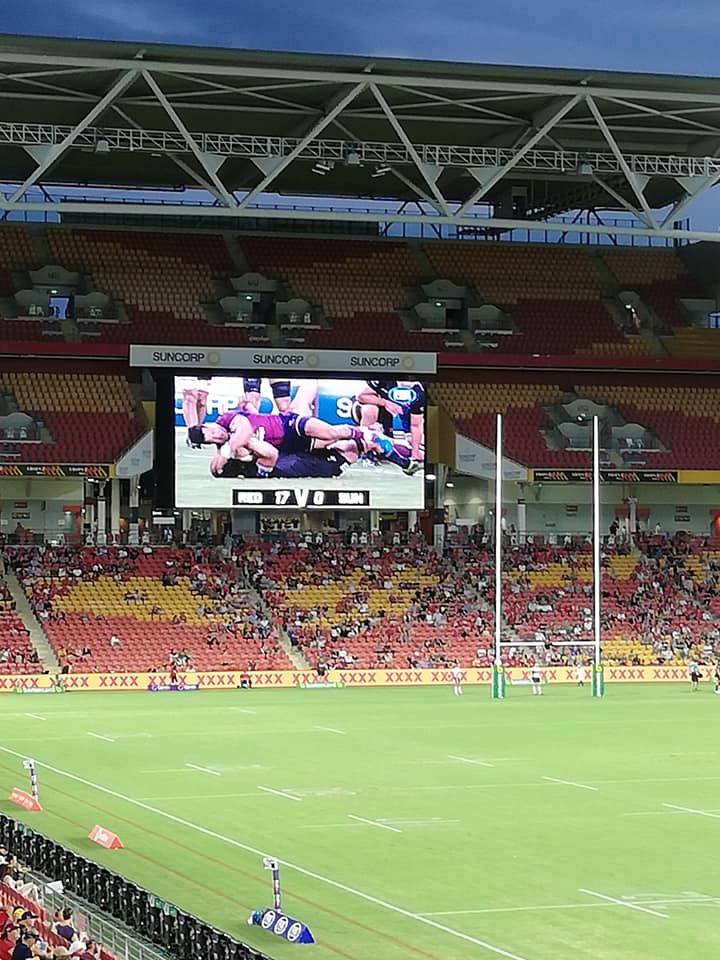
Scoreboard view early in the first half
When Wayne Smith broached the idea of joining Rapid Rugby after the Reds’ match on Saturday night, he was stonewalled with a flat bat. However, that’s the Japanese way, i.e. to confront issues by not making decisions. Brisbanerugby spent 4 months beating our head against the wall after RWC2019 in Tokyo talking to various interested parties, gleaning much insight into how the JRFU is not interested with any expansion outside the rigid paradigm of their precious Top League. Despite this WE WILL continue to push their barrow.
Almost 12,000 people (official crowd 11,798) watched the first home match for the Reds at Suncorp Stadium last night; a 37% increase from the 8,600 that last year watched this fixture against the Sunwolves. Scoring 10 tries to 1, to win 64-5, is sure to bring the faithful supporters back and Brad Thorn said he was very excited about this team. He said, having someone like Hunter Paisami coming in for the injured Jordan Petaia was a revelation. A player in the mold that Thorn likes; trains hard with a good attitude.
Thorn has said earlier this season that his younger chargers have been progressing for a number of years, whether it be Schoolboys, U19s, U20s or NRC: “90% of our players have come through the system here in Queensland, which shows what we are trying to do here.”
The prodigal son, Jame O’Conner, erased his 2015 Reds nightmare last night as he orchestrated the Reds highest ever Super Rugby score; eclipsing there previous best 53-3 in 2011 against the Rebels..
Fi James O’Conner was the crowd favourite last night at Suncorp Stadium.












 Brisbane Rugby.com